Test.com Pricing Enterprise Plans: Complete 2026 Guide

If you are researching Test.com pricing enterprise plans, you are probably trying to understand more than just the advertised subscription price. For a business, certification body, training provider, or organization managing large-scale exams, the real cost depends on testing volume, hosting, setup, integrations, certification features, security, and additional services such as proctoring.
Test.com is now closely associated with Gauge Online, the testing and certification platform operated by Test.com, Inc. Gauge is designed for organizations that need more than a basic quiz builder. It supports online assessments, certification programs, credential management, reporting, integrations, security controls, and high-volume exam delivery.
As of 2026, Gauge lists Professional and Enterprise pricing. The Professional plan starts at $750 per year, while the Enterprise plan starts at $10,000 per year. Additional hosting and setup charges apply.
This guide explains the current pricing structure, Enterprise features, potential additional costs, use cases, alternatives, and what organizations should consider before purchasing.
What Is Test.com?
Test.com is associated with an online testing and certification software business that currently presents its platform through Gauge Online.
Unlike basic online quiz tools, Gauge is built around professional assessments and certification programs. Organizations can create exams, manage question banks, control attempts and passing scores, issue certificates and badges, integrate external systems, and monitor candidate performance.
The platform is designed for organizations where testing is an important part of a larger business or credentialing process.
Typical users may include:
- Professional certification organizations
- Trade and industry associations
- Training companies
- Government programs
- Corporate certification departments
- Continuing education providers
- Organizations running high-stakes examinations
Gauge also promotes its long experience in the testing industry, including large numbers of exams and certification programs. These figures are vendor-provided claims, so organizations considering a major contract should verify relevant information during their procurement process.
Test.com Pricing Enterprise Plans in 2026

The current Gauge pricing structure provides a starting point for organizations evaluating the platform.
| Plan | Software | Hosting | Setup Fee | General Use |
|---|---|---|---|---|
| Professional | From $750/year | $250/year | $500 one-time | Growing programs |
| Enterprise | From $10,000/year | $1,000/year | $2,000 one-time | 10,000+ tests/year |
The Professional plan therefore starts at approximately $1,000 per year in recurring software and hosting costs, plus the one-time $500 setup fee.
The Enterprise plan starts at $11,000 per year when software and hosting are combined. During the first year, the additional $2,000 setup fee brings the starting total to approximately $13,000.
These figures should be treated as starting prices rather than guaranteed final costs.
For larger organizations, actual pricing can depend on testing volume, integrations, implementation requirements, and other services.
Enterprise Pricing Per Test
One important part of the Enterprise model is volume-based pricing.
Gauge states that Enterprise volume pricing starts at approximately $3 per test, with the per-test rate decreasing as testing volume increases. The company also states that its highest-volume customers may pay considerably less than $1 per test.
However, these figures should not be treated as a universal rate.
A business running 10,000 exams may receive a very different commercial proposal from an organization delivering 100,000 or more exams.
For that reason, organizations should request a customized quote that clearly identifies:
- Annual exam volume
- Included platform features
- Hosting charges
- Setup and implementation fees
- Proctoring costs
- Integration costs
- Support
- Additional usage charges
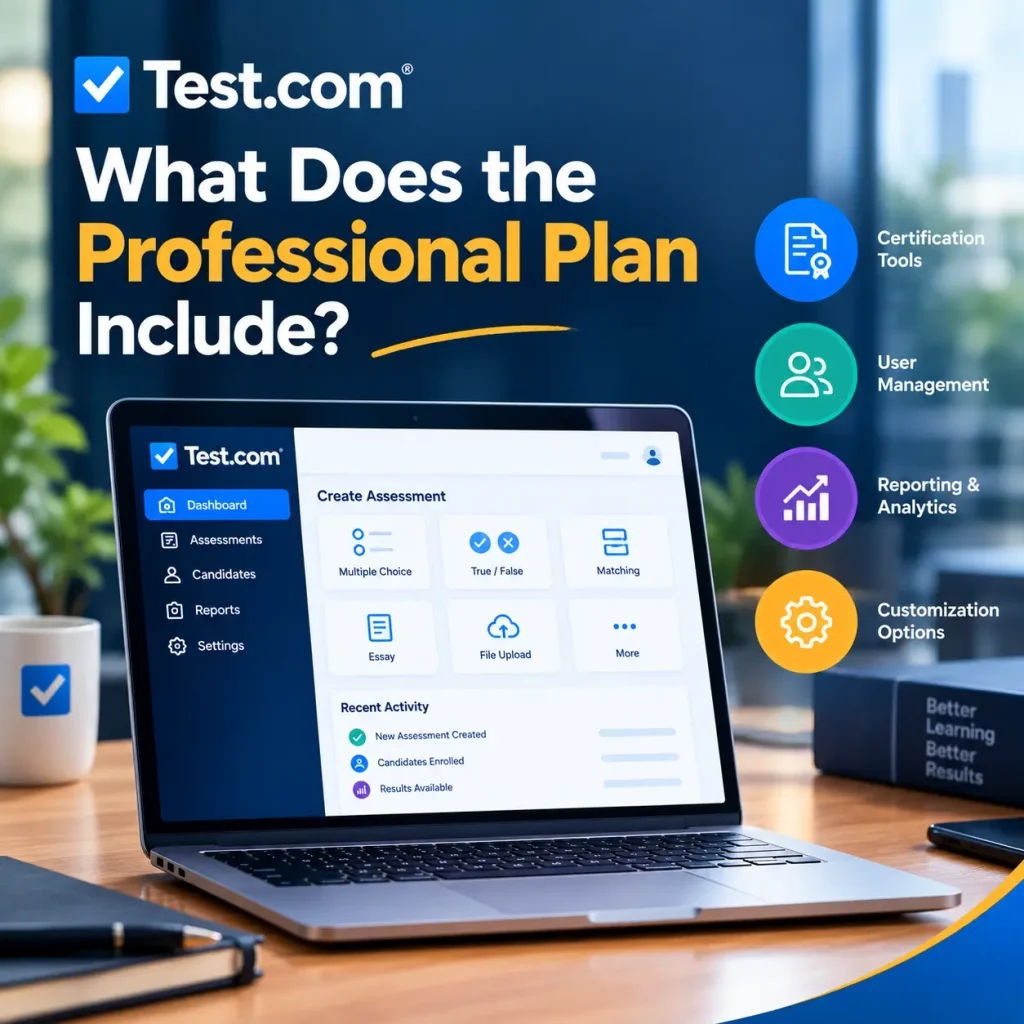
What Does the Professional Plan Include?
The Professional plan is intended for organizations that are growing their testing or certification programs but do not yet require the full Enterprise package.
It starts at $750 per year for the software, with $250 annual hosting and a $500 one-time setup fee.
The plan provides tools for creating and delivering online assessments, managing users, controlling exams, analyzing results, and customizing testing experiences.
Professional can make sense for organizations that have a smaller testing volume and want a dedicated assessment platform without immediately committing to an enterprise-level package.
However, organizations should compare their expected growth carefully. If exam volume is likely to increase significantly, moving to Enterprise may eventually become necessary.
Read also: What Is QuikConsole.com? An Honest 2026 Guide and Review
What Does the Enterprise Plan Include?
The Enterprise plan is designed for organizations delivering more than 10,000 tests annually.
Its feature set focuses on the needs of larger testing and certification operations.
Depending on the organization and selected configuration, Enterprise capabilities include:
- Certification management
- Digital badges
- Proctoring integrations
- Lessons and learning features
- eCommerce functionality
- REST API access
- Webhooks
- Single sign-on
- Advanced security controls
- User permissions
- Audit trails
- Reporting and analytics
These features become particularly useful when an organization has thousands of candidates and needs to automate processes that would otherwise require manual administration.
Key Test.com Enterprise Features
Advanced Online Testing
Gauge supports several assessment formats, including multiple-choice, matching, sorting, true/false, text-based answers, and Likert-scale questions.
Administrators can configure important exam settings such as:
- Time limits
- Attempt limits
- Passing scores
- Question randomization
- Answer randomization
- Hints
- Media
- Scoring rules
Question banks can also be reused across multiple assessments.
For organizations delivering similar exams repeatedly, these features can make assessment management more efficient.
Certification and Digital Badging
Certification is one of the major differences between a basic testing platform and a dedicated credentialing system.
Gauge allows organizations to build certification processes around exams, prerequisites, learning requirements, and other conditions.
Successful candidates can receive certificates or digital badges after meeting the required criteria.
This can reduce administrative work for organizations that need to manage thousands of certified users.
Proctoring Support
High-stakes exams often require more than standard online delivery.
Gauge provides integrations with several third-party proctoring services and also offers options for supervised testing environments.
This can be useful for professional certifications where organizations need stronger controls around exam integrity.
However, buyers should remember that platform pricing and proctoring pricing are not necessarily the same thing.
A proctoring provider may charge separately based on exam duration, candidate volume, or service type. Those costs should be included in the overall budget.
API, Webhooks, and SSO
Enterprise integrations can be especially important for large organizations.
Gauge provides REST API and webhook functionality that can allow testing information to communicate with other business systems.
Single sign-on can also connect the platform with an organization’s existing authentication environment.
For example, a company may want its assessment platform to work alongside:
- Learning management systems
- CRM software
- HR platforms
- Membership databases
- Training portals
- Internal identity systems
Integration capabilities can reduce the need for repetitive manual data entry.
Security and Access Controls
Enterprise testing programs often handle sensitive candidate and examination information.
Gauge provides security-related controls such as authentication options, SSO, IP restrictions, user groups, permissions, and audit trails.
These tools can help organizations control who can access exams and administrative functions.
For regulated or high-stakes programs, buyers should still conduct their own security review and request documentation covering encryption, data retention, backups, incident response, access management, compliance, and data-processing practices.
How Does Test.com/Gauge Work?
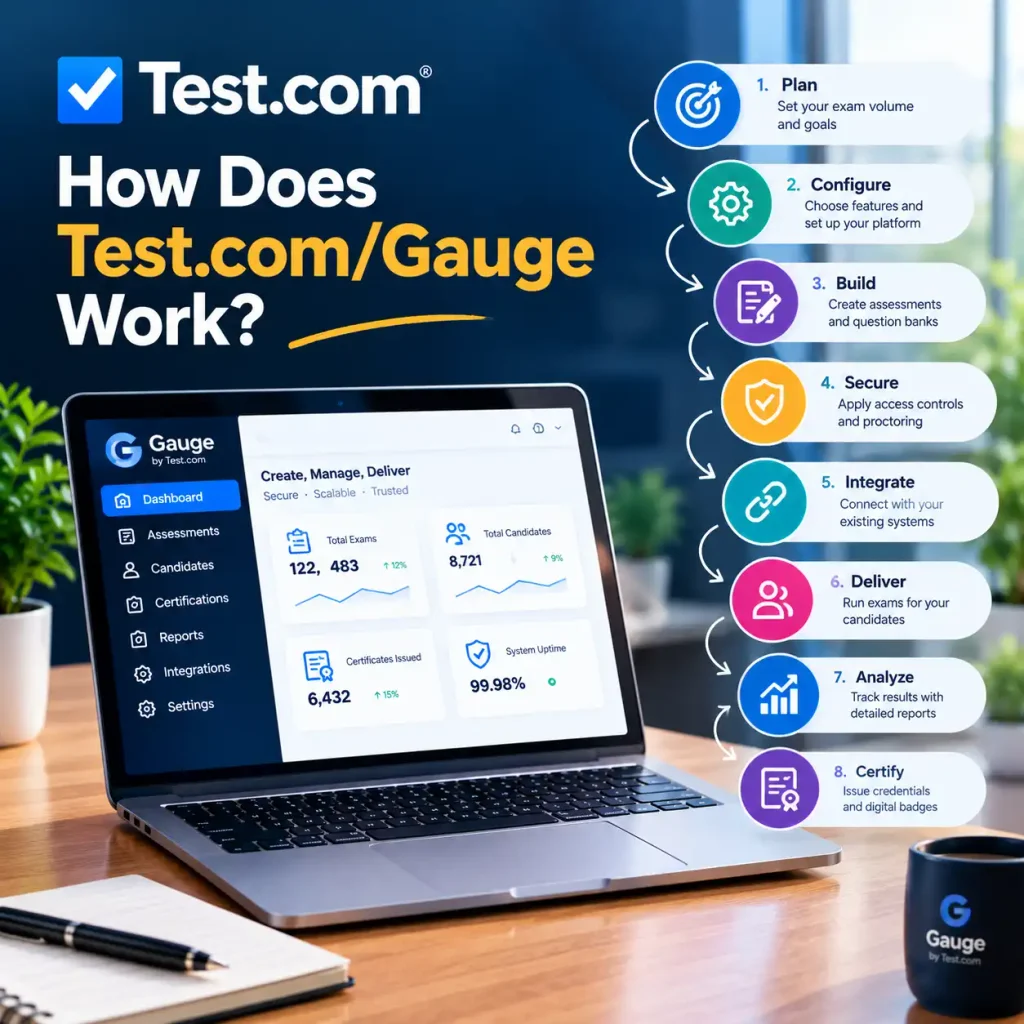
The general process can be divided into several stages.
1. Determine Exam Volume
The organization first estimates how many exams it expects to deliver annually.
Exam volume is important because it can affect the appropriate pricing structure.
2. Select Required Features
The organization identifies the features it needs, such as certification, badging, proctoring, eCommerce, API access, SSO, and reporting.
3. Build the Assessment
Administrators create exams using the available question types and configure scoring, timing, attempts, and other rules.
4. Configure Security
Access restrictions, authentication, randomization, attempt limits, and other security settings can then be established.
5. Connect Other Systems
Enterprise customers can use APIs, webhooks, and SSO to connect Gauge with existing organizational systems.
6. Deliver Exams
Candidates complete their assessments online. Where necessary, organizations can use integrated proctoring services.
7. Review Results
Administrators can monitor examination results and certification progress through reporting and analytics tools.
8. Issue Credentials
Candidates who meet the required conditions can receive certificates or digital badges.
Is Test.com Legit?
When researching Test.com pricing, some people also search for terms such as “Test.com scam” or “Is Test.com legitimate?”
The Gauge/Test.com software business presents itself as an established commercial testing and certification provider. Its website provides product information, pricing details, enterprise features, integrations, and security documentation.
The company also identifies Test.com, Inc. as the organization behind Gauge Online.
That said, businesses considering an enterprise agreement should still perform normal vendor due diligence. Published company claims should be distinguished from independently verified information.
Before making a large purchase, organizations should review the contract, privacy documentation, security information, service terms, support arrangements, and data-processing requirements.
It is also important to distinguish the testing software business from the test.com domain itself, because searches for the domain can produce unrelated information.
Pros and Cons of Test.com Enterprise
Pros
Enterprise-focused testing:
The platform is designed for organizations managing professional assessments rather than simple quizzes.
Certification management:
Certificates, badges, learning requirements, and credential workflows can be managed within the broader platform.
Integration capabilities:
API, webhook, and SSO support can make it easier to connect testing with existing systems.
Security controls:
Authentication, permissions, IP restrictions, and audit functionality can be valuable for high-stakes assessments.
Scalable pricing:
The volume-based model allows larger organizations to negotiate pricing around their testing requirements.
Cons
Enterprise pricing is only a starting point:
The advertised $10,000 annual software price does not necessarily represent the final cost for every organization.
Additional services may cost extra:
Hosting, setup, proctoring, integrations, and other requirements should be confirmed in the quote.
Learning curve:
A platform with many configuration options may take longer to learn than a simple quiz builder.
Potentially excessive for small teams:
Organizations that only need occasional internal quizzes may not need enterprise-level certification infrastructure.
Who Should Use Test.com Enterprise?
Test.com/Gauge Enterprise is primarily relevant to organizations with substantial assessment requirements.
Potential use cases include:
- Professional certification programs
- Trade associations
- Government testing programs
- Corporate certification
- Continuing education
- Training organizations
- Professional licensing programs
- Large-scale online examinations
- High-stakes assessments
The strongest use case is generally an organization that needs testing, certification, security, reporting, and integrations together.
Who May Not Need the Enterprise Plan?
Small businesses and organizations with limited testing requirements may not need Enterprise.
For example, a company that conducts only a few employee quizzes each year may find a simpler assessment tool easier to manage.
Similarly, teachers or small training teams looking primarily for basic quizzes may not need advanced certification, API, or enterprise security functionality.
The right plan therefore depends heavily on the organization’s actual testing requirements.
Read also: SnapJotz com: Features, Benefits, Safety, and How It Works
Test.com Alternatives
ClassMarker
ClassMarker is an online testing platform that may be relevant for organizations looking for assessment functionality without requiring the same level of certification infrastructure.
It can be worth comparing for smaller testing programs, particularly when simplicity and basic assessment delivery are the main requirements.
TestRail
TestRail frequently appears in searches involving the word “test,” but it serves a different purpose.
TestRail is primarily a software testing and test case management platform, rather than a professional certification exam system.
Therefore, it should not be treated as a direct alternative when the goal is delivering certification exams to external candidates.
Learning Management Systems
Traditional LMS platforms can provide courses, quizzes, learner management, and educational content.
However, organizations running professional certification programs may need additional capabilities for credentialing, secure exams, proctoring, and audit trails.
A comparison should therefore focus on the complete workflow rather than simply comparing quiz features.
Security and Privacy Considerations
Security should be an important part of any Enterprise purchasing decision.
Gauge advertises features such as SSO, authentication controls, user permissions, IP restrictions, and audit trails.
However, organizations should not rely only on product marketing when evaluating security.
Before signing an Enterprise agreement, ask the vendor for information about:
- Data encryption
- Data retention
- Backup procedures
- Incident response
- Employee access controls
- Audit logging
- Compliance certifications
- Data residency
- Subprocessors
- Privacy obligations
- Data-processing agreements
Organizations should also determine how candidate information is stored and handled and whether the platform meets their own regulatory or contractual requirements.
Is the $10,000 Enterprise Plan Worth It?
Whether the Enterprise plan makes financial sense depends on the organization’s testing volume and operational requirements.
At the published starting price, Enterprise costs $10,000 per year for software, plus $1,000 for annual hosting and a $2,000 one-time setup fee.
For an organization delivering more than 10,000 exams each year, the investment may need to be evaluated against the cost of alternative systems, manual administration, certification management, integrations, and support.
Instead of comparing only monthly subscription prices, organizations should calculate their total cost of ownership.
Consider:
- Software fees
- Hosting
- Setup
- Proctoring
- Payment processing
- Integration development
- Data migration
- Administrative labor
- Certification management
- Support
- Renewal costs
This provides a more realistic picture of what the platform will cost over several years.
Final Thoughts on Test.com Pricing Enterprise Plans
The key point when researching Test.com pricing enterprise plans is that Gauge is positioned as a professional testing and certification platform rather than a basic online quiz tool.
The published Enterprise starting price is $10,000 per year, with $1,000 annual hosting and a $2,000 one-time setup fee. Gauge also publishes volume-based Enterprise pricing beginning at approximately $3 per test, with lower rates possible at higher volumes.
The platform’s major capabilities include certification management, digital badging, proctoring integrations, APIs, webhooks, SSO, security controls, reporting, and large-scale exam delivery.
However, the advertised starting price should not be treated as the final cost for every organization.
The most practical approach is to estimate annual exam volume, identify the required features, calculate additional service costs, and request a customized written quote.
For an enterprise buyer, the final contract and complete cost breakdown are more useful than the headline starting price alone.
Frequently Asked Questions
What is Test.com Enterprise pricing in 2026?
The Enterprise plan starts at $10,000 per year for the software, with $1,000 annual hosting and a $2,000 one-time setup fee.
How much does Test.com cost per test?
Gauge states that Enterprise volume pricing starts at approximately $3 per test, with lower rates available as testing volume increases. Actual pricing depends on the organization’s agreement and volume.
Is Test.com the same as Gauge Online?
Gauge Online is the testing and certification platform associated with Test.com, Inc. It is the current public-facing platform for the company’s online assessment and certification services.
Does Test.com support proctoring?
Yes. Gauge supports integrations with third-party proctoring providers and offers options for supervised testing. Additional proctoring charges may apply.
Does Test.com support APIs and SSO?
Yes. Enterprise capabilities include REST API access, webhooks, and single sign-on, allowing organizations to integrate testing with other systems.
Who is the Test.com Enterprise plan for?
Enterprise is designed for organizations managing large testing programs, particularly those delivering more than 10,000 tests annually.
Is Test.com suitable for small businesses?
It can be, but smaller organizations should compare their actual requirements with the Professional plan and simpler testing platforms before choosing Enterprise.
What should I ask before buying Test.com Enterprise?
Ask for a customized quote based on annual exam volume and confirm all software, hosting, setup, proctoring, integration, support, renewal, and additional usage charges before signing a contract.