Stack Your Deck with These White-Label Cyber Tools

The Strategic Value of White-Label Cybersecurity for Modern MSPs
The cybersecurity landscape in 2026 is a complex battlefield. As cyber threats grow bolder and client demands for robust protection escalate, many Managed Service Providers (MSPs) face a critical challenge: how to deliver cutting-edge security without overwhelming their teams or draining their budgets. The talent shortage, with 65% of technology leaders struggling to find skilled professionals, only intensifies this pressure.
Fortunately, a powerful solution is rapidly gaining traction: white-label cybersecurity services. This approach allows MSPs to offer a full spectrum of security tools and expertise under their own brand, leveraging external providers for the heavy lifting. The white-label market itself is booming, projected to hit $75.0 billion by 2033, reflecting its strategic value in an era where agility and expanded service offerings are paramount.
In this extensive guide, we will explore how white-label cybersecurity empowers MSPs to diversify their service portfolios, generate significant recurring revenue, and strengthen client retention. We’ll uncover the most effective white-label tools available in 2026, delve into the strategic advantages of this model, and provide practical insights for selecting, integrating, and scaling these services successfully. Whether you’re considering a first entry into security or looking to expand your existing capabilities, understanding the nuances of a comprehensive white-label security platform is key to navigating today’s threat environment.
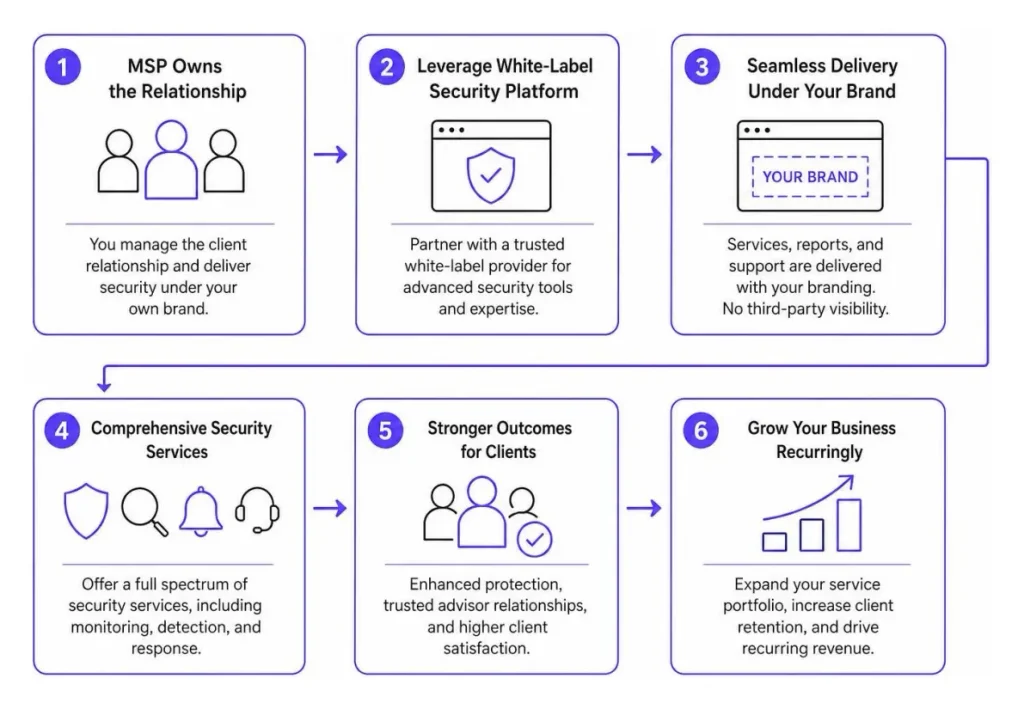
For MSPs aiming to thrive in 2026 and beyond, white-label cybersecurity isn’t just a tactical option; it’s a strategic imperative. We see it as a cornerstone for enhancing client retention and significantly expanding our profit margins. By offering a robust suite of security services under our own brand, we strengthen our position as a trusted advisor, making our clients less likely to look elsewhere. The ability to seamlessly integrate advanced security solutions, from basic monitoring to comprehensive Managed Detection and Response (MDR), without the client ever seeing a third-party logo, fosters an unbreakable brand invisibility. This deepens client trust and reinforces our value proposition.
Furthermore, aligning with white-label partners who uphold stringent certifications like SOC 2 Type II and ISO 27001 is crucial. These certifications aren’t just badges; they are proof of a commitment to security best practices and data protection, which directly translates into higher assurance for our clients and reduces our own compliance burden. This strategic alignment allows us to confidently offer sophisticated security services that meet industry standards, providing a competitive edge in a crowded market.
Feature In-House Security Development White-Label Security Partnerships Initial Investment High (staff, tools, infrastructure) Low (subscription, per-unit cost) Time to Market Long (hiring, training, setup) Short (rapid deployment) Expertise Required Deep, specialized, diverse security roles Generalist MSP knowledge, partner expertise Scalability Challenging (linear hiring, resource limits) High (on-demand expansion) Operational Overhead Significant (24/7 staffing, tool management) Minimal (partner handles operations) Brand Control Full (but requires heavy investment) Full (partner operates invisibly) Why White-Label Delivery Outpaces In-House Security Operations
Building an in-house security operations center (SOC) or even a dedicated security team is a monumental undertaking for most MSPs. The global managed services market is projected to reach $847.4 billion by 2033, partly driven by talent shortages, and cybersecurity is particularly affected. Finding and retaining skilled security analysts is incredibly difficult, with 65% of technology leaders reporting talent acquisition as harder than ever in 2026. This analyst shortage translates into exorbitant capital expenditure for salaries, training, and specialized tools.
Beyond the initial investment, the operational drag of maintaining 24/7 coverage, managing complex security information and event management (SIEM) systems, and staying abreast of evolving threats can quickly overwhelm an MSP’s resources. White-label delivery, however, sidesteps these hurdles. It allows us to leverage a partner’s existing infrastructure, expert staff, and mature processes, ensuring continuous monitoring and rapid response capabilities without the associated overhead. This model provides unparalleled scalability, enabling us to expand our security offerings to meet growing client demand without the need for linear hiring or massive upfront investments. We can simply scale up our partnership as our client base grows, maintaining efficiency and profitability.
Capitalizing on Regulatory Mandates Like NIS2
The regulatory landscape is becoming increasingly complex, and for European MSPs, the NIS2 Directive presents both a challenge and a significant opportunity. NIS2 expands cybersecurity obligations to a broader range of entities, including many service providers, making MSPs directly liable for the security of their clients’ systems. This supply chain liability means that our clients, and by extension, we ourselves, must demonstrate robust security postures.
White-label security services are perfectly positioned to help us capitalize on this mandate. Platforms designed for NIS2 compliance can offer automated reporting, awareness training, phishing simulations, and dark web monitoring, all essential components for achieving and maintaining compliance. For instance, an MSP in the Netherlands generated €150,000 in revenue within nine months by offering NIS2 as a service, demonstrating the clear market demand. These white-label solutions turn a compliance burden into a recurring revenue stream, offering audit readiness and continuous governance without requiring us to become NIS2 experts overnight. We can provide our clients with the tools and reports they need to satisfy regulatory requirements, reinforcing our role as their essential security partner.
Core Components of WhiteDog’s White-Label Security Platform Stack
To truly deliver comprehensive and effective cybersecurity services, MSPs need a white-label platform that is not only robust but also seamlessly integrates with their existing operational tools. A multi-tenant security architecture is paramount, allowing us to manage multiple client environments from a single, centralized dashboard. This design ensures tenant isolation, preventing any cross-contamination of data or security incidents between clients, which is critical for maintaining trust and compliance.
Crucially, the platform must offer extensive API integrations and RMM (Remote Monitoring and Management) compatibility. This allows for automated provisioning, streamlined incident response, and synchronized asset management. Furthermore, strong PSA (Professional Services Automation) automation is essential for efficient ticketing, billing, and reporting. A platform that can automatically generate service tickets based on security alerts, or integrate security data into client reports, dramatically reduces manual effort and improves operational efficiency.
For a deeper dive into the foundational elements that make up a robust white-label security offering, we often refer to resources like WhiteDog’s white-label security platform. Understanding these core components is key to building a scalable and resilient security practice.
Layering WhiteDog’s White-Label Security Platform for Tiered Service Offerings
One of the most effective strategies for monetizing white-label cybersecurity is to offer tiered packaging. This allows us to cater to clients with varying budgets and security needs, from basic protection to advanced, proactive defense. By layering services, we can create clear pathways for service monetization and upsells.
For instance, a foundational tier might include essential services like dark web monitoring and security awareness training. As clients’ needs evolve, we can introduce intermediate tiers that add incident response planning and regular vulnerability assessments. The highest tier could encompass comprehensive vCISO (Virtual Chief Information Security Officer) services, providing strategic guidance and compliance oversight. This approach not only makes security more accessible to a wider range of clients but also enables us to demonstrate increasing value over time, fostering long-term relationships and predictable recurring revenue. Each layer builds upon the last, creating a cohesive and progressively more secure environment for our clients.
Deep Tooling: White-Label SOC, MDR, and Telemetry Integration
For clients requiring the highest level of protection, white-label SOC (Security Operations Center) and MDR (Managed Detection and Response) services are indispensable. These advanced offerings provide continuous monitoring of client environments, leveraging sophisticated tools to detect and respond to threats in real-time. MDR services go beyond simple alerting, incorporating active threat hunting by expert analysts to uncover stealthy attacks that automated systems might miss.
Effective white-label SOC/MDR relies heavily on comprehensive telemetry integration. This involves collecting security data from various sources—endpoints, networks, cloud environments, and applications—and feeding it into a centralized SIEM (Security Information and Event Management) system. The SIEM then correlates these diverse data points to identify patterns indicative of malicious activity. Once a threat is detected, the white-label partner’s SOC team initiates automated remediation actions or provides clear, actionable guidance for our team to implement, ensuring rapid containment and recovery. This “deep tooling” allows us to offer enterprise-grade security capabilities to our SMB clients without the prohibitive cost and complexity of building and staffing our own 24/7 SOC.
Evaluating White-Label Security Entry Points: From Monitoring to Full MDR
Choosing the right entry point for offering white-label cybersecurity services is a critical decision for MSPs. It depends on our clients’ existing security maturity, our team’s current capabilities, and our strategic business goals. While full MDR and SOC services represent the pinnacle of security offerings, simpler monitoring services can serve as an excellent, low-friction entry point, especially for clients new to managed security.
Feature Entry-Point Monitoring Services Full White-Label MDR and SOC Services Complexity Low (easy to explain and implement) High (requires deeper understanding) Client Engagement Proactive alerts, simple actions Continuous collaboration, strategic guidance Revenue Potential Consistent, recurring, upsell opportunities Higher contract value, long-term commitment Required MSP Expertise General IT knowledge, basic security concepts Intermediate to advanced security understanding Threat Coverage Specific threats (e.g., credential leaks) Comprehensive (prevention, detection, response, hunting) Operational Overhead (for MSP) Very low (automated alerts, simple reporting) Moderate (client liaison, incident validation) Lightweight Offerings: Dark Web Scans, Phishing, and Cloud Audits
For many MSPs, starting with lightweight white-label security offerings is the most effective approach. These services are easy to explain to clients, have a low operational overhead, and provide immediate, tangible value. Dark web monitoring, for instance, provides crucial insights into credential exposure, alerting clients when their login details appear on illicit forums. This is a clear, actionable problem that clients readily understand and appreciate. Half of UK businesses reported a cyber breach or attack in the last 12 months, making the commercial case for such services undeniable.
Similarly, white-label phishing simulation and security awareness training platforms are excellent for bolstering human defenses, which remain the weakest link in many organizations. DMARC (Domain-based Message Authentication, Reporting & Conformance) enforcement can protect clients from email spoofing and brand impersonation, while Microsoft 365 audit services ensure cloud configurations adhere to best practices. These low-friction sales often lead to follow-on projects, as each alert or audit finding can trigger recommendations for password resets, MFA rollouts, or further training, creating additional revenue streams without heavy fulfillment costs.
Advanced Deliverables: White-Label SOC and Penetration Testing
As our clients’ security maturity grows, or as their regulatory requirements become more stringent, we can introduce more advanced white-label services like full SOC capabilities and penetration testing. While dark web monitoring and phishing simulations provide excellent entry points, white-label SOC services offer continuous, 24/7 monitoring, threat detection, and incident response, acting as a virtual security team for our clients.
White-label penetration testing, on the other hand, provides a proactive assessment of an organization’s security posture. This involves manual pentesting conducted by certified experts, often holding credentials like CREST or OSCP. These testers simulate real-world attacks to identify vulnerabilities in systems, applications, and networks before malicious actors can exploit them. The white-label partner delivers comprehensive executive reporting, branded with our logo, detailing findings and providing actionable recommendations for vulnerability remediation. This allows us to offer high-value, specialized security assessments that would otherwise require significant in-house expertise and investment, further solidifying our role as a comprehensive security provider.
Best Practices for Integrating and Scaling White-Label Services
Successfully integrating and scaling white-label cybersecurity services requires careful planning and adherence to best practices. The goal is to make the white-label partner an invisible extension of our team, ensuring seamless operations from our clients’ perspective. This means focusing on robust ticketing automation, meticulous brand preservation, efficient customer onboarding, and clear SLA (Service Level Agreement) alignment.
We must ensure that security alerts and incidents from the white-label platform automatically generate tickets within our PSA system, allowing our technicians to manage them efficiently. Brand preservation is paramount; all client-facing communications, reports, and portals must carry our branding exclusively. A smooth customer onboarding process, ideally automated and quick, minimizes friction and ensures rapid time-to-value for our clients. Finally, aligning our client-facing SLAs with our white-label partner’s internal SLAs is crucial to consistently meet customer expectations and maintain trust.
Seamless Operations with WhiteDog’s White-Label Security Platform
Operational efficiency is key to profitability when scaling white-label services. A premium white-label security platform should offer deep integrations with the tools MSPs already rely on. This includes robust Autotask integration and ConnectWise sync capabilities, which allow for automated provisioning, ticketing, and reporting directly within our existing PSA environment.
Furthermore, the availability of comprehensive REST APIs enables us to build custom integrations and extend the platform’s functionality to suit our unique operational workflows. This level of integration supports automated provisioning of services, ensuring that new clients can be onboarded quickly and efficiently. Centralized telemetry collection from all client environments feeds into a unified dashboard, providing our team with a holistic view of security posture and enabling proactive management. This seamless integration reduces manual tasks, minimizes errors, and allows our team to focus on higher-value activities, ultimately enhancing our service delivery and client satisfaction.
Commercial Models and Calculating Margin Potential
Understanding the typical pricing models for white-label cybersecurity services is essential for calculating potential margins and structuring our own offerings. Most white-label providers use models such as per-seat pricing (per user), per-device tiers, or per-endpoint pricing. Some may also offer project-based pricing for services like penetration testing or vCISO engagements.
To calculate our potential margins, we typically subtract the white-label partner’s cost from our client-facing price. For example, if a white-label dark web monitoring service costs us $X per user per month, and we charge our client $Y per user per month, our margin is $Y-$X. The key is to maintain strong margin control by selecting partners that offer distributor-level pricing or favorable partner programs. This allows us to offer competitive pricing to our clients while ensuring healthy profitability. These predictable revenue streams, combined with effective cross-sell strategies (e.g., selling MFA after a dark web alert), contribute significantly to our overall business growth and financial stability.
Frequently Asked Questions About White-Label Cyber Security
How does white labeling differ from traditional reseller models?
The fundamental difference lies in brand ownership and customer interaction. In a white-label model, the end client interacts solely with our MSP’s brand. The services are delivered by the white-label provider but are completely rebranded as our own. The client is unaware a third party is involved. This ensures complete brand invisibility and allows us to maintain full control over the customer touchpoints and relationship. In contrast, traditional reseller or referral models typically involve handing off some or all of the client relationship to the third-party vendor, or the vendor’s brand remains visible to the client. White labeling is underpinned by strict confidentiality agreements, ensuring our client data and our partnership details remain private, preserving our brand integrity and margin control.
How do MSPs ensure complete brand invisibility?
Ensuring complete brand invisibility is paramount for a successful white-label partnership. This is achieved through several key mechanisms. First, the white-label platform should support custom domains and full branding customization, allowing us to configure portals and dashboards with our logo, colors, and messaging. Second, all client-facing communications, including automated alerts, reports, and invoices, must be fully white-labeled, appearing as if they originate directly from our MSP. Third, masked communications, where the white-label partner’s underlying infrastructure is obscured, are crucial for technical interactions. Finally, robust non-disclosure agreements (NDAs) with the white-label provider are essential to legally protect our client relationships and the confidentiality of the partnership.
What compliance certifications should a security partner hold?
When selecting a white-label cybersecurity partner, their compliance certifications are a strong indicator of their commitment to security and data protection. We should prioritize partners who hold:
- ISO 27001: This international standard for information security management systems demonstrates a systematic approach to managing sensitive company and customer information.
- SOC 2 Type II: This report attests to the effectiveness of a service organization’s controls relevant to security, availability, processing integrity, confidentiality, and privacy over a period of time. It’s a critical assurance for handling client data.
- CREST certification: For white-label penetration testing or advanced security services, CREST-certified personnel indicate a high level of technical proficiency and ethical conduct in security testing.
- NIS2 alignment: Especially for MSPs operating in Europe, a partner’s alignment with the NIS2 Directive’s requirements ensures they can help us and our clients meet regulatory obligations for critical infrastructure and essential services. These certifications provide us with the confidence that our white-label partner adheres to the highest industry standards.
Conclusion
In the rapidly evolving cybersecurity landscape of 2026, white-label cybersecurity tools are no longer a luxury but a necessity for forward-thinking MSPs. This extensive guide has demonstrated how embracing a white-label model enables us to achieve significant portfolio diversification, offering a comprehensive suite of security services from dark web monitoring to full MDR and SOC capabilities. It provides a powerful competitive differentiation, allowing us to stand out in a crowded market by delivering enterprise-grade security without the prohibitive costs and complexities of building it in-house.
White-label partnerships are a strategic pathway to enhanced client retention and robust recurring revenue streams. By leveraging the expertise and infrastructure of specialized providers, we can efficiently scale our services, meet growing client demands, and capitalize on emerging opportunities like NIS2 compliance. The future of managed services is secure, and it’s white-labeled.
Read also: Best Telescopes for Beginners: Top Picks for Stargazing







1 Comment
[…] Read also: Stack Your Deck with These White-Label Cyber Tools […]