40 Similes for Complex Ideas Explained Simply for Beginners
Understanding a difficult idea is not always easy, especially when the subject involves complicated systems, emotions, decisions, or abstract concepts. One of the best ways to make a difficult idea easier to understand is by using a simile.
Similes for complex ideas compare something difficult with something familiar. They often use words such as “like” or “as” to create a clear mental picture. Instead of explaining a complicated subject with several sentences, a good simile can help readers understand the main idea almost instantly.
For beginners, learning how to use similes can improve vocabulary, communication, creative writing, and everyday explanations. In this guide, you will find 40 similes for complex ideas, along with their meanings and practical examples.
What Are Similes for Complex Ideas?
Similes for complex ideas are comparisons that make difficult subjects easier to understand. They connect an unfamiliar or complicated concept to something people already know.
For example:
“The new software system was like a maze with moving walls.”
This comparison suggests that the software was difficult to understand and that its challenges seemed to change constantly.
The purpose is not simply to make writing sound creative. A strong simile should help the reader understand the subject more clearly.
Why Are Similes Useful?
Similes can:
- Make abstract ideas easier to visualize
- Explain difficult concepts in simple language
- Make writing more interesting
- Help readers remember information
- Improve creative and descriptive writing
- Make everyday communication more effective
What Is a Simile?
A simile is a figure of speech that compares two different things by using words such as “like” or “as.”
For example:
“Learning a new language is like climbing a long staircase.”
The sentence compares language learning to climbing stairs because both require gradual progress and effort.
Simile vs. Metaphor
A simile makes a direct comparison using “like” or “as.”
Simile: The problem is like a puzzle.
A metaphor makes the comparison directly.
Metaphor: The problem is a puzzle.
Both can explain difficult ideas, but similes are often especially helpful for beginners because the comparison is clearly signaled.
40 Similes for Complex Ideas With Meanings and Examples
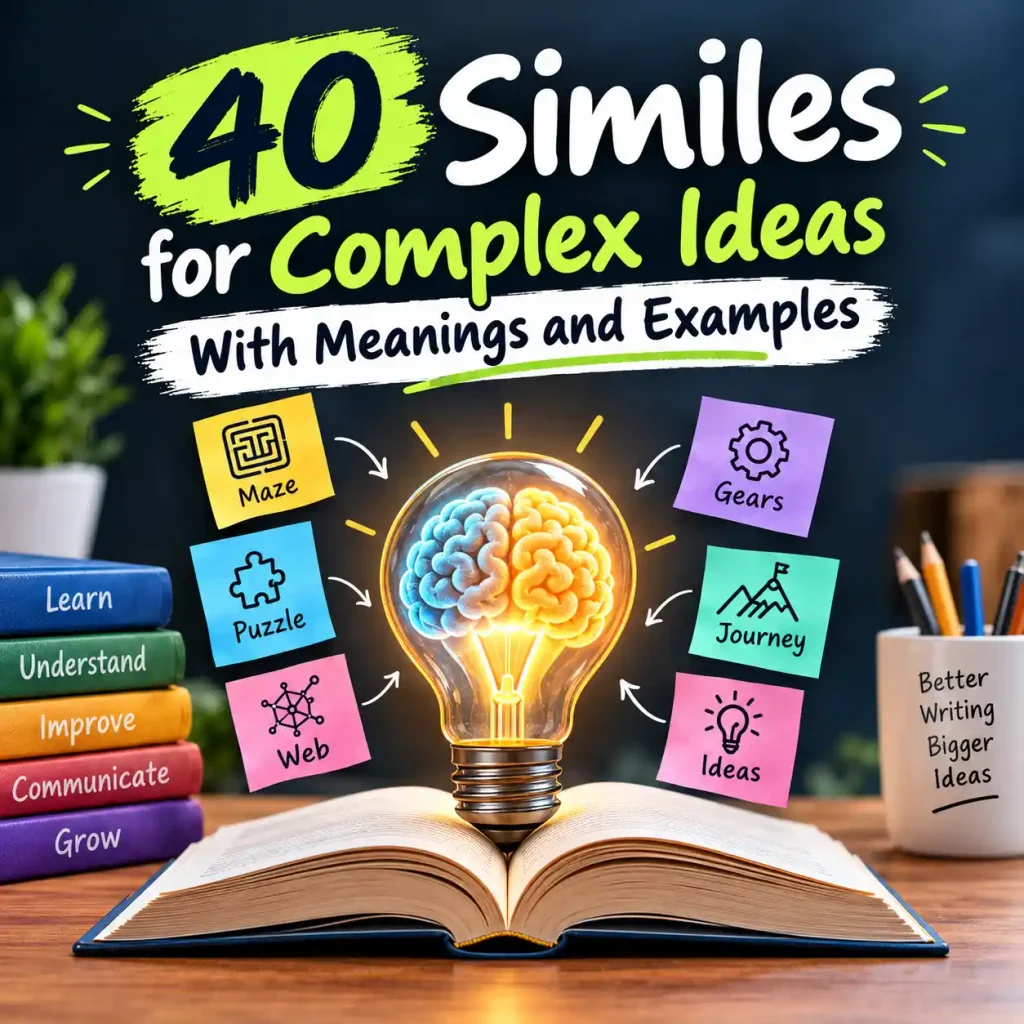
Here are 40 useful similes that can describe complicated ideas, systems, emotions, problems, and situations.
1. As Complex as a Maze With Moving Walls
Meaning: Something is difficult to understand because the challenges keep changing.
Example:
The new business strategy was as complex as a maze with moving walls.
2. Like a Puzzle That Keeps Changing Shape
Meaning: A situation becomes difficult because its parts are constantly changing.
Example:
Managing the project was like a puzzle that kept changing shape.
3. As Complex as Tangled Fishing Lines
Meaning: Several connected problems are mixed together and difficult to separate.
Example:
Their family problems were as complex as tangled fishing lines.
4. Like a Coded Message Without a Key
Meaning: Something is impossible or very difficult to understand without additional information.
Example:
The technical report looked like a coded message without a key.
5. As Complex as Layers of Shifting Sand
Meaning: A situation has several unstable parts that can change unexpectedly.
Example:
The company’s internal structure was as complex as layers of shifting sand.
6. Like a Clock With Invisible Gears
Meaning: A system appears simple from the outside but has hidden processes working underneath.
Example:
The website worked like a clock with invisible gears.
7. As Complex as a City Full of Hidden Streets
Meaning: Something contains many different paths, connections, and possibilities.
Example:
The legal system was as complex as a city full of hidden streets.
8. Like a Map Written in Symbols
Meaning: Information is available, but understanding it requires interpretation.
Example:
The statistics looked like a map written in symbols to the beginner.
9. As Complex as Overlapping Shadows
Meaning: Different factors make a situation unclear or difficult to interpret.
Example:
His feelings were as complex as overlapping shadows.
10. Like a Knot Pulled Tighter With Every Thought
Meaning: Overthinking makes an already difficult problem even harder.
Example:
The decision became like a knot pulled tighter with every thought.
11. As Complex as Ripples Crossing on Water
Meaning: Different actions influence one another in complicated ways.
Example:
The effects of the new policy were as complex as ripples crossing on water.
12. Like Threads Woven Without a Clear Pattern
Meaning: Ideas or information are connected but difficult to organize.
Example:
His explanation sounded like threads woven without a clear pattern.
13. As Complex as a Storm of Conflicting Voices
Meaning: Many different opinions or ideas make something difficult to understand.
Example:
The debate became as complex as a storm of conflicting voices.
14. Like Mirrors Facing Mirrors
Meaning: An idea seems to continue endlessly or repeatedly reflect itself.
Example:
The philosophical argument was like mirrors facing mirrors.
15. As Complex as Paths Crossing in Fog
Meaning: There are many possible choices, but the correct direction is unclear.
Example:
Choosing the right career felt as complex as paths crossing in fog.
16. Like a Book Without an Index
Meaning: Information exists, but finding the right part is difficult.
Example:
The research database was like a book without an index.
17. As Complex as Interlocking Puzzles
Meaning: Different problems are connected, so solving one may affect another.
Example:
Running the organization was as complex as interlocking puzzles.
18. Like Wires Crossed Behind a Wall
Meaning: Confusion exists beneath the surface and cannot easily be seen.
Example:
The company’s communication system was like wires crossed behind a wall.
19. As Complex as Shifting Constellations
Meaning: A system constantly changes as its different parts move.
Example:
The financial market can be as complex as shifting constellations.
20. Like a Recipe Rewritten While Cooking
Meaning: The rules or instructions keep changing during the process.
Example:
Completing the project was like a recipe rewritten while cooking.
21. As Complex as Echoes in a Canyon
Meaning: One action can create several effects that continue to interact.
Example:
The consequences of the decision were as complex as echoes in a canyon.
22. Like a Web Rebuilt Overnight
Meaning: Something develops quickly and creates new connections.
Example:
The online community grew like a web rebuilt overnight.
23. As Complex as Thoughts Stacked on Thoughts
Meaning: Too many ideas are layered together, creating mental overload.
Example:
Trying to solve everything at once felt as complex as thoughts stacked on thoughts.
24. Like Doors Leading to More Doors
Meaning: Solving one issue reveals several additional issues.
Example:
Investigating the problem was like opening doors that led to more doors.
25. As Complex as Tides Pulling in Opposite Directions
Meaning: Conflicting forces make a decision difficult.
Example:
The business decision was as complex as tides pulling in opposite directions.
26. Like Pages Shuffled in a Book
Meaning: Useful information exists, but it is presented in the wrong order.
Example:
The instructions were like pages shuffled in a book.
27. As Complex as Patterns Forming in Smoke
Meaning: Something seems to have a pattern, but the structure is difficult to identify.
Example:
The theory was as complex as patterns forming in smoke.
28. Like a Language Without Familiar Words
Meaning: Something is difficult to understand because the reader does not recognize its basic elements.
Example:
The technical manual felt like a language without familiar words.
29. As Complex as Roots Beneath Solid Ground
Meaning: Something has hidden causes or foundations that extend much deeper than they appear.
Example:
The country’s history is as complex as roots beneath solid ground.
30. Like Signals Crossing Through Static
Meaning: Information becomes unclear because too many signals or distractions interfere.
Example:
The meeting was like signals crossing through static.
31. As Complex as a Forest at Night
Meaning: A situation has hidden details and an uncertain direction.
Example:
The future seemed as complex as a forest at night.
32. Like a Story Told Out of Order
Meaning: The information is difficult to understand because it does not follow a logical sequence.
Example:
His explanation was like a story told out of order.
33. As Complex as Gears Turning Together
Meaning: Several parts must work together for the entire system to function.
Example:
A successful business is as complex as gears turning together.
34. Like Waves Colliding During a Storm
Meaning: Different forces or emotions interact in a chaotic way.
Example:
Her thoughts were like waves colliding during a storm.
35. As Complex as Layers of History
Meaning: Something has developed through many stages over a long period.
Example:
Modern culture is as complex as layers of history.
36. Like a Machine Built From Mismatched Parts
Meaning: A system contains many parts that do not work together efficiently.
Example:
The old management process was like a machine built from mismatched parts.
37. As Complex as Layers of Glass
Meaning: Something may look clear on the surface while still containing several deeper layers.
Example:
The issue was as complex as layers of glass.
38. Like Footprints Overlapping in Snow
Meaning: Different clues, actions, or events make it difficult to determine what happened first.
Example:
The investigation was like following footprints overlapping in snow.
39. As Complex as Voices in a Crowded Room
Meaning: Too many opinions or sources of information create confusion.
Example:
The online discussion was as complex as voices in a crowded room.
40. Like a Mirror Cracked Into Many Pieces
Meaning: A single idea or situation has been divided into many disconnected parts.
Example:
His understanding of the subject was like a mirror cracked into many pieces.
Positive and Negative Similes for Complex Ideas
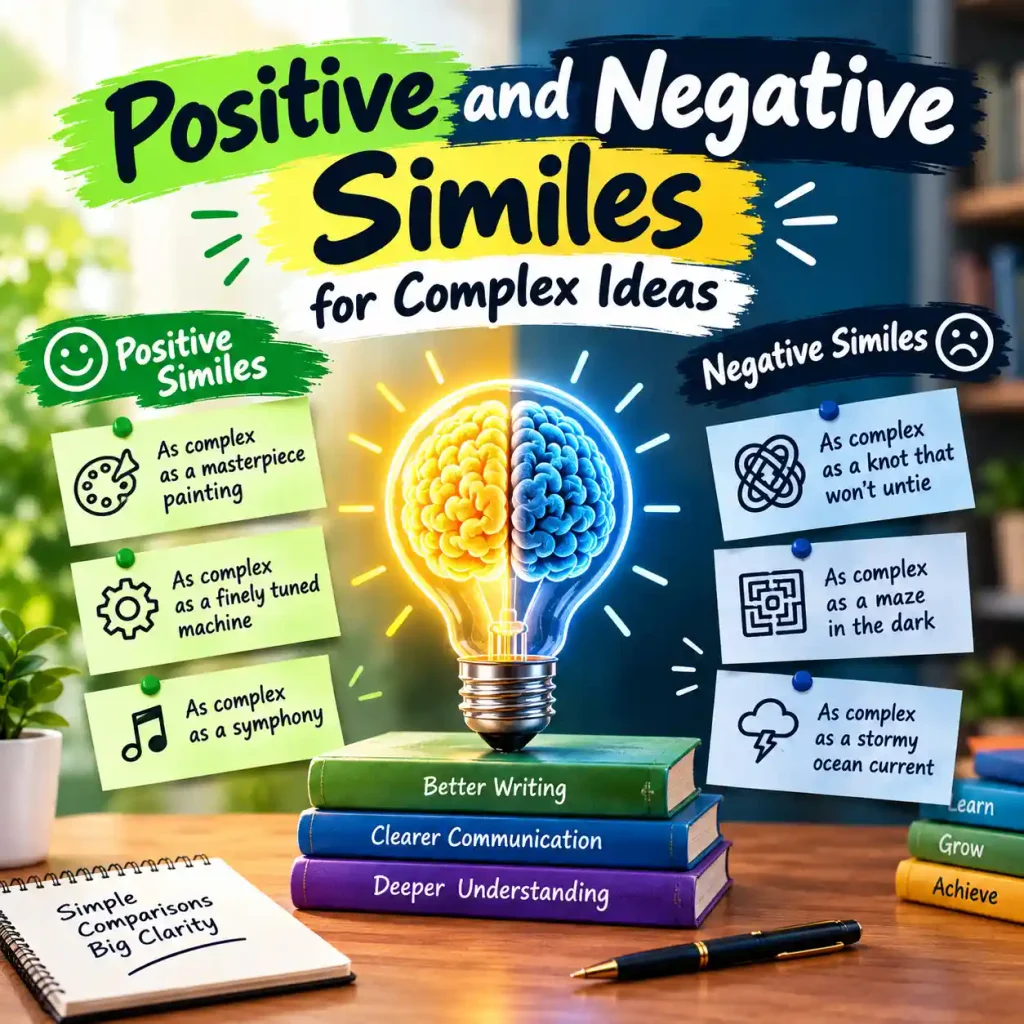
Complexity does not always have a negative meaning. Sometimes it shows intelligence, beauty, detail, or careful design. In other situations, complexity creates confusion and frustration.
Read also: Hello There: The Obi-Wan Kenobi Meme, Origin, History and Meaning
Positive Similes
As Complex as a Masterpiece Painting
This suggests detailed, thoughtful, and impressive complexity.
Example:
Her business strategy was as complex as a masterpiece painting.
As Complex as a Finely Tuned Machine
This describes something complicated but organized and efficient.
Example:
The company’s workflow operated like a finely tuned machine.
As Complex as a Symphony
This suggests that many individual elements work together beautifully.
Example:
The entire production was as complex as a symphony.
Negative Similes
As Complex as a Knot That Will Not Untie
This emphasizes frustration and difficulty.
Example:
The tax regulations were as complex as a knot that would not untie.
As Complex as a Maze in the Dark
This suggests confusion and a lack of direction.
Example:
Learning the new software felt as complex as a maze in the dark.
Real-Life Examples of Complex Similes
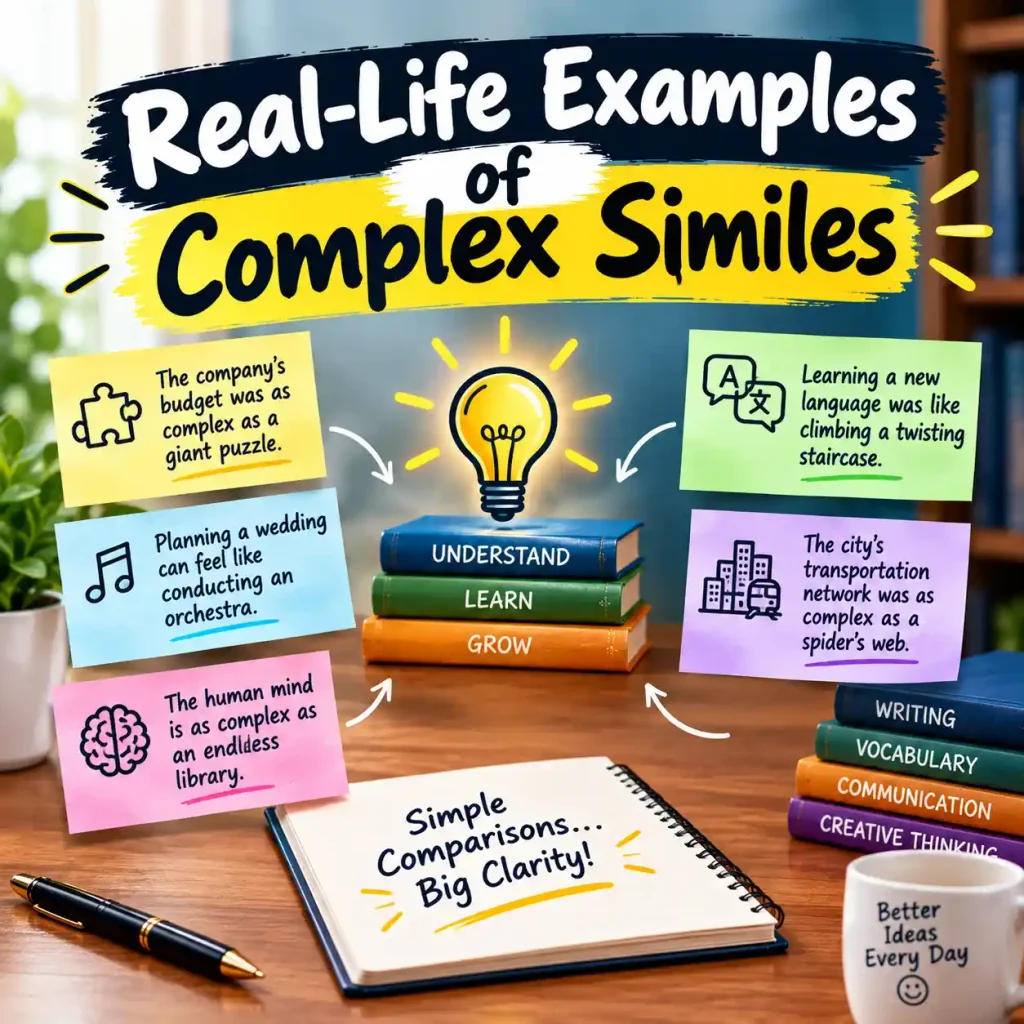
Similes become more useful when they are applied to everyday situations.
- The company’s budget was as complex as a giant puzzle.
This suggests that the budget contained many connected details. - Planning a large event was like conducting an orchestra.
This shows that many separate tasks had to work together. - The human mind is as complex as an endless library.
This comparison highlights the huge amount of information, memory, and thought within the mind. - Learning a new language was like climbing a twisting staircase.
It suggests that progress happens gradually through several challenging stages. - The city’s transportation network was as complex as a spider’s web.
This shows how many roads, routes, and connections are linked together.
How to Create Your Own Similes for Complex Ideas
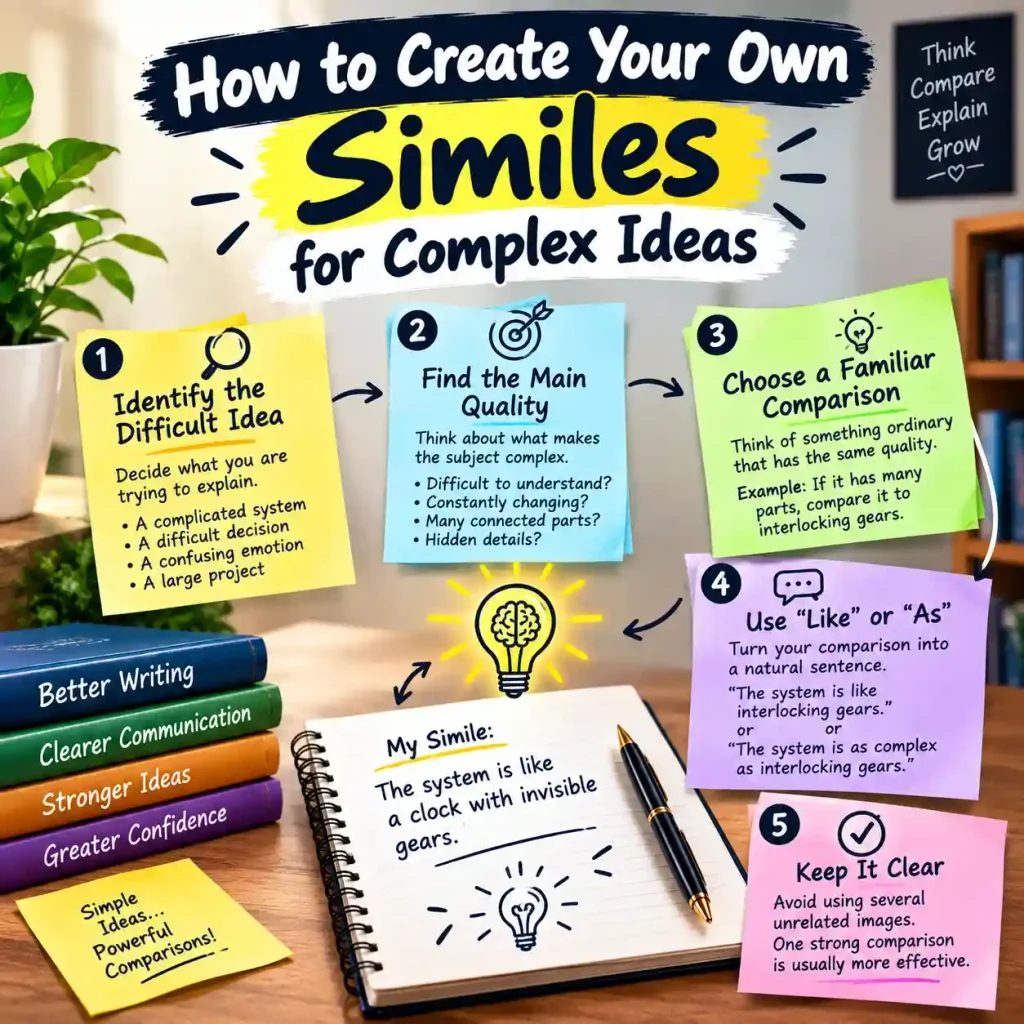
You do not have to memorize every simile. You can create your own by following a few simple steps.
1. Identify the Difficult Idea
First, decide what you are trying to explain.
It could be:
- A complicated system
- A difficult decision
- A confusing emotion
- A large project
- A scientific concept
- A complicated relationship
2. Identify Its Main Quality
Ask what makes the subject complex.
Is it:
- Difficult to understand?
- Constantly changing?
- Made of many parts?
- Full of hidden details?
- Confusing?
- Connected to many other things?
3. Find a Familiar Comparison
Think of something ordinary that has the same quality.
For example, if a system has many connected parts, you could compare it to interlocking gears.
4. Use “Like” or “As”
Turn your comparison into a natural sentence.
The system is like interlocking gears.
Or:
The system is as complex as interlocking gears.
5. Keep the Comparison Clear
Avoid combining several unrelated images in one sentence. One strong comparison is usually more effective than four weak ones.
Common Mistakes When Using Similes
Even a creative simile can become confusing if it is used incorrectly.
Using Too Many Similes
Using several comparisons in one paragraph can distract readers.
Weak:
The idea was like a maze, a storm, a puzzle, a knot, and a forest.
Better:
The idea was like a maze with moving walls.
Choosing an Unfamiliar Comparison
A simile should make an idea easier, not harder.
Choose images that your target audience can understand quickly.
Mixing Different Images
Avoid starting with one comparison and suddenly switching to another.
Keep the imagery consistent throughout the sentence or paragraph.
Making the Simile Too Complicated
The purpose of a simile is to simplify an idea. If the comparison itself requires a long explanation, choose a simpler image.
Why Similes Make Complex Ideas Easier
Similes work because people often understand familiar experiences more quickly than abstract explanations.
For example, saying:
“The system has many interconnected components that influence each other.”
is accurate but somewhat formal.
A simpler comparison is:
“The system is like a set of gears turning together.”
The second version creates an immediate visual image.
Similes can therefore support:
- Better comprehension
- Stronger memory
- Clearer communication
- More engaging writing
- Easier learning
Tips for Using Similes Effectively
For the best results, remember these simple rules:
- Know your audience. Use comparisons they are likely to understand.
- Choose one clear idea. Do not make the comparison overly complicated.
- Use familiar imagery. Puzzles, maps, roads, gears, and books are easy to visualize.
- Match the emotion. A storm may suggest chaos, while a symphony can suggest harmony.
- Do not overuse similes. A few strong comparisons are better than many unnecessary ones.
- Explain when necessary. If the comparison could be misunderstood, briefly clarify its meaning.
Quick Comparison Table
| Simile | Main Meaning | Best Used For |
|---|---|---|
| Maze with moving walls | Changing difficulty | Problems |
| Tangled fishing lines | Entangled issues | Relationships |
| Clock with invisible gears | Hidden processes | Systems |
| Puzzle that changes shape | Constant change | Projects |
| Doors leading to more doors | Endless layers | Investigations |
| Signals crossing through static | Communication problems | Discussions |
| Gears turning together | Interdependence | Organizations |
| Forest at night | Uncertainty | Future situations |
| Layers of history | Accumulated depth | Culture and history |
| Mirror cracked into pieces | Fragmentation | Ideas and information |
Frequently Asked Questions
What are similes for complex ideas?
Similes for complex ideas are comparisons that use familiar objects, situations, or experiences to make difficult concepts easier to understand.
Why are similes useful for explaining difficult ideas?
They turn abstract or complicated concepts into visual comparisons that readers can understand more quickly.
Can similes simplify difficult topics?
Yes. A well-chosen simile can explain the structure, difficulty, uncertainty, or relationships within a complicated topic in a simple way.
Are similes appropriate for academic writing?
Yes, but they should be used carefully. In academic writing, similes are most effective when they clarify an idea rather than simply decorate the writing.
What is an easy example of a simile for something complex?
A simple example is:
“The problem was like a thousand-piece puzzle.”
It suggests that the problem has many parts and requires time and effort to solve.
How can I create my own simile?
Identify the main quality of the difficult idea, find a familiar object or experience with the same quality, and connect them using “like” or “as.”
What is the difference between a simile and a metaphor?
A simile compares two things using words such as “like” or “as.” A metaphor makes the comparison directly without using those words.
Conclusion
Similes for complex ideas are useful tools for making difficult subjects easier to understand. By comparing complicated systems, emotions, decisions, and concepts with familiar experiences, writers can create clearer explanations and stronger mental images.
The best similes are simple, relevant, and easy to visualize. Whether you are writing an essay, explaining a technical subject, teaching beginners, or improving your everyday communication, the right comparison can make a complicated idea feel much more approachable.
Start with a familiar image, focus on one main quality, and avoid unnecessary complexity. With practice, you can create effective similes that turn difficult ideas into clear and memorable explanations.