Random Number Generator: A Complete Guide to Generating Random Numbers
🎲 Random Number Generator
Generate random numbers, pick from a list, roll dice or flip a coin — instantly, in your browser.
Integer formula: floor(random × (max − min + 1)) + min • Both min and max are inclusive.
Standard choice: 2 dice with 6 sides. Change sides for D4, D8, D10, D12, D20 or D100.
50 / 50 chance: Heads or Tails, every flip independent.
History
Your last 20 generations are saved on this device only. Nothing is sent to a server.
- No generations yet.
Random Number Generator: The Complete Guide
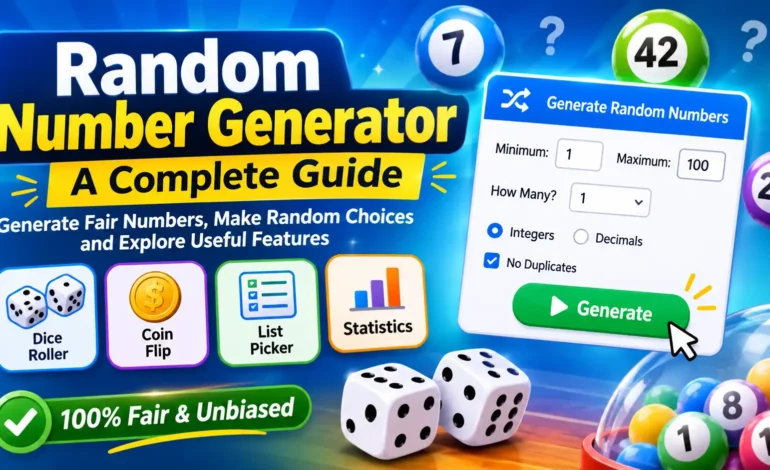
Need a fair number, a quick decision, or a random sample for a class project? A random number generator takes the guesswork — and the bias — out of the choice. This guide explains what the tool above does, how to use every mode, and how to read the results with confidence.
What Is a Random Number Generator?
A random number generator (RNG) is a tool that produces numbers with no predictable pattern. Every value inside the range you choose has the same chance of appearing, and one result does not influence the next. That fairness is exactly why RNGs are used in so many places: lottery draws, classroom activities, research sampling, games, simulations, and everyday decisions like picking a winner or settling a friendly debate.
Most online generators, including this one, are pseudorandom. That sounds like a weakness, but for normal use it is not. The generator starts from unpredictable system entropy — things like timing and hardware state on your device — and then follows a fixed mathematical rule. The result feels random because, in practice, you cannot predict it. For games, teaching, sampling, and simulations, pseudorandom numbers are more than good enough.
How to Use This Random Number Generator
The tool has four tabs. You do not need an account, and nothing you generate is sent to a server.
1. Numbers tab
- Set your range. Type a minimum and a maximum. Both can be negative, zero, or positive.
- Choose how many numbers you need. The default is 1, and you can generate up to 10,000 at once.
- Pick integer or decimal. Integers are whole numbers. Decimal mode lets you choose 1 to 4 decimal places.
- Decide about duplicates. Leave “Allow duplicates” on if repeats are fine. Turn it off when every number must be different.
- Click Generate. Then copy the result, download it as TXT or CSV, or click “Generate Again” to roll again with the same settings.
Short on time? The preset buttons fill in common setups instantly, including 1 to 100 and a 6-number lottery draw from 1 to 49.
2. List Picker tab
Type one item per line — names, teams, prizes, ideas, anything — choose how many picks you want, and let the tool choose for you. Turn repeats off when each item should only be picked once.
3. Dice tab
Choose how many dice to roll and how many sides each die has. Two 6-sided dice is the classic setup, but you can also roll D4, D8, D10, D12, D20, or D100 for board games and role-playing games.
4. Coin Flip tab
Choose how many flips you want. Each flip is an independent 50/50 call between Heads and Tails, so a run of Heads does not make Tails “due” next time.
The Formula Behind the Numbers
The tool is transparent about its maths. For integers, it uses:
result = floor(random() × (max − min + 1)) + minHere, random() gives a value from 0 up to, but not including, 1. Multiplying by the size of the range and rounding down maps that value onto a whole number, and adding the minimum shifts it into your range. Both ends are inclusive: if you ask for 1 to 10, both 1 and 10 can appear.
For decimals, the idea is simpler:
result = round(min + random() × (max − min), decimal_places)This is why a decimal result can land anywhere between the minimum and maximum, not just on whole numbers.
Generating Random Numbers Without Repeats
Sometimes repeats would ruin the result. A lottery draw should not contain the same number twice, a seating plan should not assign the same seat to two people, and a research sample should not count the same person twice.
That is what the “Allow duplicates” switch is for. Turn it off, and the tool uses a shuffle-based method: it shuffles the whole range and then takes the first numbers you asked for. Every result is guaranteed unique — as long as the request is possible.
The one hard limit is maths, not the tool. You cannot ask for 10 unique numbers from a range that only contains 5 values, because there are only 5 different answers available. In that case, either reduce the quantity, widen the range, or allow duplicates. For integers, the maximum number of unique results is always max − min + 1.
Random Number Generator Examples
| What you want | Settings | Why it works |
|---|---|---|
| A quick number from 1 to 10 | Min 1, Max 10, Quantity 1, Integer | Each number has a 10% chance — great for classroom games and quick decisions. |
| A number from 1 to 100 | Min 1, Max 100, Quantity 1, Integer | Each number has a 1% chance — useful for percentages, tests, and demos. |
| 6 lottery numbers | Min 1, Max 49, Quantity 6, Duplicates off | Every set of 6 is equally likely, and no number repeats. |
| A decimal between 0 and 1 | Min 0, Max 1, Decimal, 4 places | This is the classic uniform value used in probability and simulation. |
| Only negative numbers | Min −100, Max 0, Integer | Negative ranges work exactly like positive ones. |
| A sample of 20 from 200 people | Min 1, Max 200, Quantity 20, Duplicates off | This is simple random sampling without replacement — a fair, unbiased sample. |
| A random decimal like −2.37 | Min −5, Max 5, Decimal, 2 places | Handy for physics problems, simulations, and practice data. |
How to Read the Statistics Summary
When you generate more than one number, the tool shows a short summary. Here is what each figure means in plain English:
- Count: how many numbers were generated.
- Min / Max: the smallest and largest values in this particular set.
- Mean: the average — add all the numbers up and divide by the count.
- Median: the middle value when the numbers are sorted. Half are below it, half are above it.
- Sum: all the numbers added together.
One thing surprises people: a small random set often looks uneven. Ten numbers from 1 to 10 will frequently include repeats and gaps, and that is completely normal. Random does not mean “perfectly spread out.” It means every value had the same chance. Evenness only shows up over a large number of draws.
List Picker, Dice, and Coin Flip: When to Use Each
Random List Picker
Use this when your choices are words, not numbers. It is ideal for giveaway winners, picking a student to answer first, randomising the order of presentations, choosing a restaurant from a shortlist, or assigning teams. If you want a full random order, set the number of picks equal to the number of items and turn repeats off.
Dice Roller
Use this when you need the feel of a real dice roll without the dice. Board games, classroom probability lessons, and tabletop games all work well here. The total is shown automatically, so you do not have to add the dice yourself.
Coin Flip
Use this for a simple yes/no decision or to decide who goes first. With multiple flips, the Heads and Tails counts help you see how a fair coin behaves over time — and why short runs can still look lopsided.
Pseudorandom vs. Truly Random Numbers
A pseudorandom generator follows a deterministic rule from a starting seed. Give it the same seed, and it will produce the same sequence — which is actually useful when you want a result you can reproduce for a study or a lesson.
A truly random generator, by contrast, measures something physical, such as atmospheric noise or radioactive decay. Nobody can reproduce its output from a seed, because there is no seed in the usual sense.
For everyday purposes, the difference does not matter. A good pseudorandom generator passes statistical tests and behaves like a truly random one. The line only matters for security. Standard random functions are not suitable for passwords, encryption keys, tokens, or gambling systems. For those, use a cryptographically secure source, such as your operating system’s secure random function or, in the browser, crypto.getRandomValues().
Generating Random Numbers in Code
If you ever need the same idea in a program, these are the standard starting points:
# Python — one integer from 1 to 100
import random
result = random.randint(1, 100)

# Python — 6 unique integers from 1 to 49
lottery = random.sample(range(1, 50), 6)
// JavaScript — one integer from min to max, inclusive (secure version)
// Uses crypto.getRandomValues with rejection sampling, not Math.random().
function secureInt(min, max) {
const range = max - min + 1;
const limit = Math.floor(4294967296 / range) * range;
const a = new Uint32Array(1);
while (true) {
crypto.getRandomValues(a);
if (a[0] < limit) return min + (a[0] % range);
}
}
const result = secureInt(min, max);# R — 5 unique integers from 1 to 100
sample(1:100, 5, replace = FALSE)For a secure random value in Python, use the secrets module instead of random. The rule is simple: use ordinary random functions for games and simulations, and secure random functions for anything that protects an account or a secret.
Common Mistakes to Avoid
- Asking for more unique numbers than the range allows. Check that quantity is no larger than
max − min + 1when duplicates are off. - Expecting a small sample to look even. Repeats and gaps are normal in random data.
- Treating the maximum as exclusive. In this tool, the maximum is inclusive — it can be generated.
- Using a normal RNG for security. Never use it for passwords, tokens, or encryption keys.
- Thinking a coin or die has a memory. After five Heads in a row, the next flip is still 50/50.
- Forgetting to check the settings before a second roll. “Generate Again” reuses your last settings, which is convenient — until you wanted different ones.
Frequently Asked Questions
How do I generate a random number between 1 and 100?
Set Minimum to 1, Maximum to 100, leave Quantity at 1, and click Generate. Every number from 1 to 100 has an equal 1% chance.
How do I generate random numbers without repeats?
Turn off “Allow duplicates” before you generate. The tool then shuffles the range and returns only unique values. If your quantity is larger than the range, it will tell you to reduce it.
Can I generate decimal numbers?
Yes. Choose Decimal as the number type and pick 1 to 4 decimal places. You can also use decimal values for the minimum and maximum.
Can I generate negative random numbers?
Yes. Just type a negative number as the minimum — for example, −50 to 50 gives you a mix of negative, zero, and positive values.
How many numbers can I generate at once?
Up to 10,000 in one generation. For larger sets, download the CSV and work with it in a spreadsheet, Python, or R.
Is this tool really random, or is it AI?
It is not AI. It uses a standard random function in your browser, seeded by your device’s entropy. There is no model, no prediction, and no decision-making behind the result.
Are my results saved online?
No. Your recent generations are stored only in your own browser, and you can clear them at any time with the Clear button under History.
Can I use the results in a spreadsheet?
Yes. Download CSV for a clean column of values, or TXT if you just want a simple list you can paste anywhere.
Bottom line: set a range, choose how many numbers you need, decide whether repeats are allowed, and let the tool do the fair part. Randomness is not about getting a “nice-looking” set — it is about giving every possible answer the same honest chance.
Read also: Hypackel: Free Browser Games, Features & Guide