Sonion: The Full Story Behind the Internet’s Favorite Typo
Introduction
The internet loves nothing more than turning a simple misspelling into a full-blown cultural moment, and “Sonion” is the latest word to earn that honor. Interestingly, the term has grown into two related but distinct internet phenomena that share the same silly name: the “Sonion Ring” meme, which reimagines the humble onion ring as a luxury item, and the “Sonion” reaction image, a viral exploitable built from an already-famous crying meme template. Together, these two threads show how a single goofy word can spread across platforms, formats, and communities in completely different directions.
What Is the “Sonion Ring” Meme?
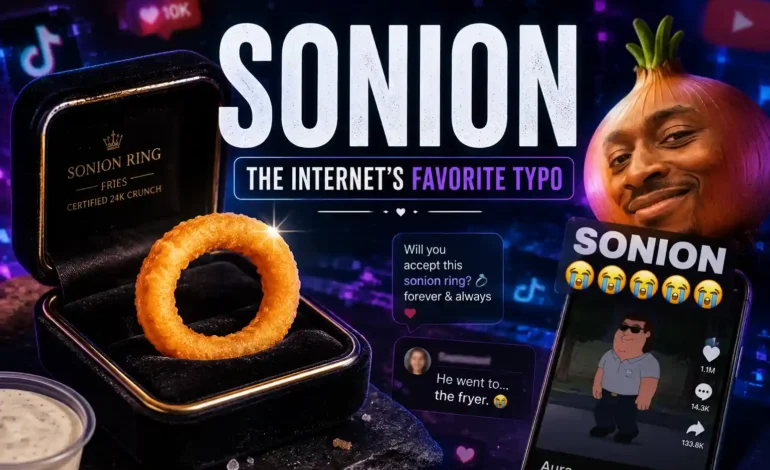
The “Sonion Ring” meme is a delightful typo-turned-treasure. People take the humble onion ring and present it like a priceless jewel, usually with captions that treat it as a proposal-worthy ring. The gag hinges on the misspelling “sonion,” a goofy, slightly cursed mashup that feels like autocorrect, baby talk, or just peak internet whimsy. It is extremely snackable humor: a visual of an onion ring in a velvet box, a deadpan caption, and instantly you have crispy comedy.
This is a fresh breakout moment, with chatter popping up around April 20, 2026. The core format is simple and repeatable, which is precisely why it spread so quickly: one image, one silly word, and infinite possible spins.
Why It Works
There are a few reasons this particular joke has resonated so widely:
- Low-stakes absurdity: Turning fast food into fine jewelry is the kind of everyday surrealism the internet loves.
- Typos as comedy gold: “Sonion” reads like a fat-finger fail or a toddler’s first attempt at ordering food. Misspellings signal play rather than precision, which makes them perfect meme fuel.
- Instant visual punchline: No context is required. An onion ring sitting in a ring box sells the joke in half a second.
- Endless remix potential: You can swap the ring, change the caption, or layer on new scenarios, and the joke still lands.
Common Formats
The meme tends to appear in a handful of recognizable formats:
- The Proposal: A velvet box opens to reveal a single onion ring, paired with a mock-sincere caption about eternal love and dipping sauces.
- The Menu Switcheroo: Screenshots of orders or menu boards where “onion” mysteriously becomes “sonion,” accompanied by deadpan reactions.
- High-Low Contrast: A luxury-ad parody complete with moody lighting, macro close-ups, and a brand voice that takes a fried circle far too seriously.
- Wordplay Chains: Reply threads that riff with adjacent typos such as “garlick,” “pomtato,” or “dionut ring,” escalating the chaos with each response.
Sample captions that circulate with the format include lines like a mock marriage proposal built around a “sonion ring,” or a joke about receiving a fried onion ring instead of a diamond and calling it richer.
How to Make Your Own
For anyone wanting to join in, the format is easy to replicate:
- Grab the visual: Snap a photo of an onion ring in a ring box, balanced on a napkin, or perched on a finger. Natural light gives it instant elegance.
- Keep the caption dry: The straighter the tone, the funnier the joke. Treat it like a Tiffany advertisement rather than a food fight.
- Lean into the typo: Spell it “sonion” consistently, since that misspelling is the meme’s secret spice.
- Add a twist: Pair the image with dramatic vows, fake product specs, or a luxury pricing gag.
A few caption starters that fit the tone: framing the onion ring as “certified 24K crunch,” joking that “he went to… the fryer,” describing it as “cut, set, and slightly salted,” or offering an “upgrade to the family heirloom” with double-battering.
Where It Fits in the Meme Ecosystem
The “Sonion Ring” meme sits comfortably alongside other typo-born classics and food-luxury crossovers. It is part keyboard chaos (the internet’s enduring love of misspellings), part object replacement (swapping high-value items with mundane ones), and part brand parody (pushing advertising tropes to comedic extremes). Anyone who has enjoyed similar jokes involving misspelled fried foods or designer-bag parodies featuring grocery produce will feel right at home with this one.
Will It Last?
The format will probably stick around for a season, long enough to circle the timeline a few times before recurring whenever fried food discourse returns. Its staying power comes from its flexibility: as long as there are ring boxes and snacks, there will be new spins on the joke. If a fast-food brand ever winks at the meme directly, that could give it extra longevity, since memes that brands can safely embrace tend to keep circulating.
Posting Tips
For anyone trying to make their own version land well:
- Use clean visuals: Simple backgrounds make the joke pop.
- Don’t over-explain: Trust the image. One crisp line beats a long paragraph.
- Time the drop: Weeknight evenings or weekend scroll windows tend to be prime times for snack humor.
- Invite riffs: Ask followers to propose with their “finest sonions” and watch the replies stack up.
The Other Sonion: A Reaction Image and Exploitable
Separately from the onion ring joke, “Sonion” is also the name of a reaction image, also known as “Sonion Ring” or “Son Onion Meme.” This version is a derivative of the original “Son 😭” meme from late 2025. It alters an image of actor Anthony Mackie smirking, giving him the visual likeness of an onion with his face protruding from the plant, while keeping the trailing string of “Loudly Crying Face” emojis (😭) from the original template. This image began spreading across various social media platforms in early 2026, and later became attached to a catchphrase associated with an adjacent meme featuring the character Tom Tucker from Family Guy.
Origin
This Sonion reaction image is a derivative of the “Son 😭😭😭😭😭” meme, which was itself a variation of the earlier “Anthony Mackie’s Smirk” meme. It is unclear who created the very first Sonion image, but the earliest known example was posted on TikTok by user thecoolibroski on February 9th, 2026. That post garnered over 1,400 likes and 75 comments within two months.
Spread
While the reaction image circulated through comment sections on various platforms throughout early 2026, functioning especially well as a TikTok sticker, the word “Sonion” became increasingly tied to an unrelated video: a clip of Tom Tucker walking slowly, set to slowed, pitched-down audio.
The spread of that connection can be traced through a few key posts:
- On March 1st, 2026, TikTok user @greenscreens4memes posted the video of Tucker walking with the simple caption “Aura.” That video received over 1.1 million views and 143,800 likes in just over a month.
- On March 29th, 2026, the same Tom Tucker clip was used in a Minecraft video posted by TikTok user @meenvon, in which the word “Sonion” was combined directly with the clip. That video received over 604,800 views and 133,800 likes in just over a week.
- On April 2nd, 2026, Redditor AchatinnTheReal posted the Sonion reaction image alongside several similar reaction images to a subreddit, garnering over 320 upvotes and 40 comments within five days.
Read also: Quandale Dingle: Origin, Biography, Powers & Meme Explained
Two Memes, One Name
Taken together, these two “Sonion” phenomena illustrate an interesting quirk of internet culture: the same invented word can spawn entirely separate meme lineages that share nothing but their spelling. One traces back to a lighthearted joke about turning fast food into luxury jewelry, complete with mock-proposal captions and parody advertising. The other traces back to a reaction image built on a well-established crying-emoji template, which then attached itself to an unrelated slowed-down video clip. Both spread rapidly across TikTok, Reddit, and other platforms in the first half of 2026, showing just how quickly a single silly typo can generate multiple, independently evolving strands of online humor.
Final Thoughts
Whether someone encounters “Sonion” as a velvet-boxed onion ring standing in for a diamond, or as an onion-faced reaction image trailing crying emojis, the appeal comes from the same place: absurd juxtaposition delivered with a straight face. The format is simple enough that anyone can join in, remix it, and keep it circulating, which is exactly why both versions of the joke managed to spread so far, so fast, across such different corners of the internet.