How Do You Do, Fellow Kids? Memes, Language, and the Comedy of Not Quite Fitting In
Introduction
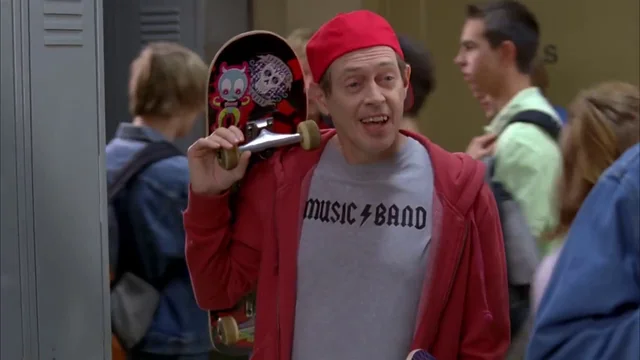
Somewhere in the last decade, a single reaction image quietly became one of the most recognisable pieces of internet culture: Steve Buscemi, dressed head to toe in “teen attire,” skateboard tucked under his arm, wearing a t-shirt that simply reads “Music Band.” The caption writes itself — “How do you do, fellow kids?” It looks like the kind of image that sprang fully formed out of the internet’s collective unconscious, the way so many memes seem to. But this one has a real origin, a real joke behind it, and, strangely enough, a real connection to academic theories of language and communication. Pulling on that thread says a lot not just about why the image is funny, but about why memes in general have become such a central, almost essential, part of how people talk to each other online.
Where the Meme Actually Comes From
The image comes from the sitcom 30 Rock, where Steve Buscemi plays an undercover police officer recalling his time on a task force of “young looking cops” sent to infiltrate high schools. In the flashback, he strolls down a school corridor in full teenage costume, skateboard included, doing everything right visually. Then he opens his mouth. Rather than attempting teen slang or a younger register, he simply asks, in his own unmistakably adult voice, “How do you do, fellow kids?” The gap between the effort put into looking the part and the total failure to sound the part is the entire joke.
Why It’s Funny: Linguistic Expectancy Theory
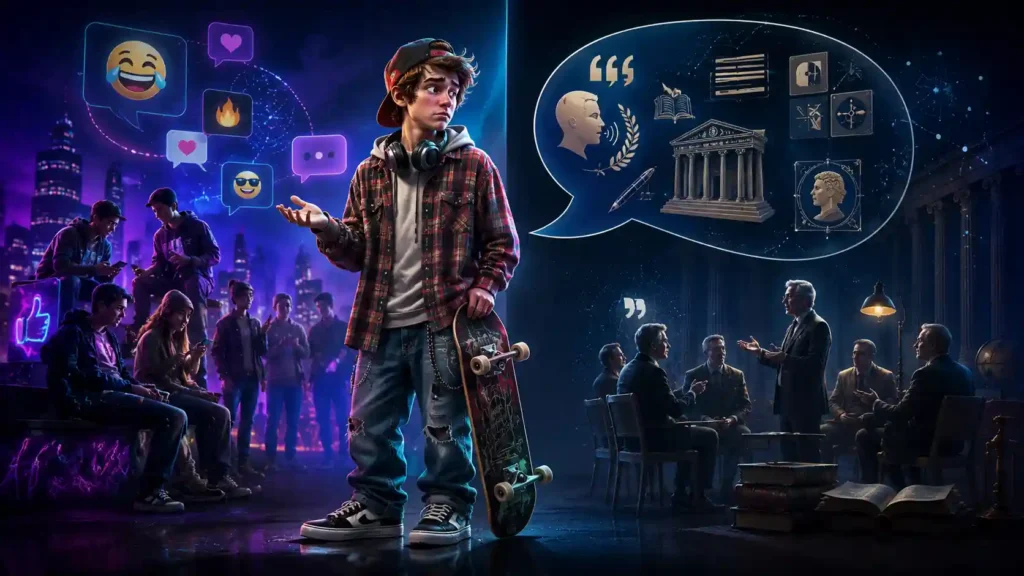
That gap has a name in linguistics: Linguistic Expectancy Theory. The basic idea is straightforward — people build expectations about how someone will speak based on how that person looks, dresses, and presents themselves in a given context. A skateboard and a slouchy t-shirt set up an expectation of casual teen speech. When Buscemi’s character instead produces a stiff, formal greeting, the mismatch between the visual signal and the linguistic reality is what triggers the laugh. This same mechanism explains why a poorly done accent impression tends to land as cringeworthy rather than convincing: we’ve been primed for one thing and delivered another, and the mind registers the mismatch instantly, often before we can even articulate what feels off.
A Deeper Layer: Communication Accommodation Theory
There’s a second, more subtle layer worth unpacking, related to a broader framework called Communication Accommodation Theory, or CAT. CAT covers the many ways people adjust — or deliberately don’t adjust — their speech depending on who they’re talking to, whether to signal closeness, distance, authority, or belonging. It’s a large and branching area of study, but one distinction inside it is especially useful for making sense of the Buscemi scene: the difference between what a speaker intends to do and what they actually manage to do.
Researchers describe this as the difference between psychological accommodation, meaning the speaker’s underlying motivation to adapt and fit in, and linguistic accommodation, meaning whatever actually comes out of their mouth. The two don’t always line up. In the sketch, Buscemi’s character has clearly poured real effort into psychological accommodation — the costume, the skateboard, the whole physical performance is built around a genuine desire to pass as one of “the fellow kids.” But none of that effort translates into linguistic accommodation. His actual speech doesn’t shift at all; he sounds exactly as he would in a police briefing. It’s easy to imagine that, in his own mind, he believes he’s nailing the disguise completely, oblivious to how badly the language gives him away. That blind confidence is arguably what makes the moment funny rather than just awkward — he isn’t in on the joke.
Once you see this pattern, it’s hard to unsee it. A huge amount of comedy, especially the comedy of failed disguises, failed impressions, and failed attempts to fit in with a group, runs on exactly this gap between trying hard and sounding right.
Memes as a Language of Their Own
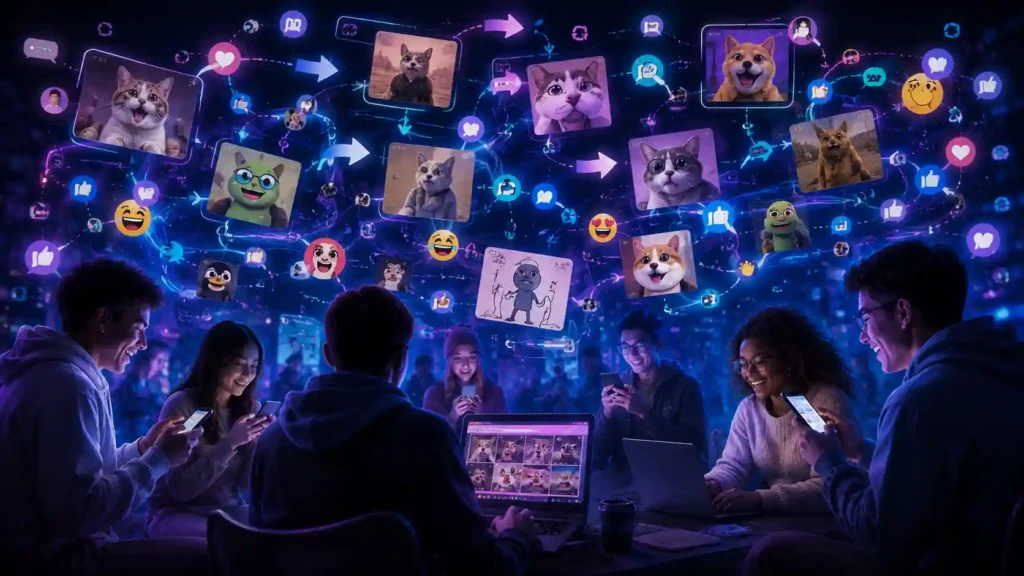
Zooming out from this one meme to internet memes as a category, there’s an argument to be made that they function as a kind of communication in their own right, one with its own grammar, in-jokes, and social rules. Memes are essentially a visual descendant of the chain emails and forwarded jokes that circulated over text and email in the 1990s and 2000s, except faster, more visual, and far more collaborative.
One defining feature of memes is that they resist ownership. Once an image or format takes off, it stops belonging to whoever made it and becomes shared property, endlessly remixed and recaptioned. Claiming credit for a meme you didn’t originate is treated as bad form, almost a violation of the unwritten etiquette that keeps the format working. That communal, no-attribution structure is part of what gives memes their political and social charge. They aren’t really about slapstick or pure observational humour so much as a shared, wry commentary on the state of things — whatever “the state of things” happens to be that week. Video platforms in particular have become fertile ground for this kind of politically tinged humour, with short clips managing to communicate complex ideas, like the scale of billionaire wealth compared to an ordinary person’s, in a way that lands instantly and spreads fast.
Sonion: The Full Story Behind the Internet’s Favorite Typo
The Pull of Memes, Even for the Reluctant
Not everyone comes to memes easily, though, and plenty of people have a genuinely conflicted relationship with them. There’s a familiar tension between loving the format and resenting how much time it can swallow. Dancing baby videos, anthropomorphised cat clips, and endless topical humour are the kind of content it’s easy to promise yourself you’ll scroll past, especially when there’s serious work or reading competing for the same attention — the mental image of a browser cluttered with a dozen-plus open tabs of “important” material, sitting there unread while a meme account gets another five minutes, will be familiar to almost anyone who has tried to be disciplined about internet use.
That discipline tends to break down under stress, and few periods have tested it quite like extended stretches of isolation, whether from lockdowns, illness, or simply life circumstances that keep people indoors and online. In moments like these, leaning into memes — including ones about the very situation causing the stress — stops feeling like a guilty indulgence and starts feeling like a coping mechanism. It’s a very small, very fast way to signal solidarity: this is absurd, and we both know it’s absurd, and here’s a picture that proves we’re thinking about it the same way.
When Memes Become a Family Language
This shift is especially visible in the way older, less terminally-online relatives adopt memes once circumstances push them onto messaging apps more often. A daily “good morning” text stops being just words and becomes an occasion for an elaborate gif, a wholesome image, or a short video, sent with obvious delight. It’s not unusual for a family member to send a meme from one room and then physically appear a minute later, half-laughing, asking if you’ve seen “the cat that looks like it’s praying” — and, infuriatingly, the cat usually does look like it’s praying, and it usually is funny.
There’s something almost embarrassing about recognising this pattern in yourself: fully embracing memeing, as both noun and verb, at the exact moment everyone around you has already been doing it for a decade, and then compulsively following up on a meme you sent to ask whether the other person got the joke, over-explaining the punchline until it stops being funny at all. That instinct — to over-analyse a meme instead of just letting it land — is, in a neat bit of symmetry, its own small performance of “How do you do, fellow kids?” Just as Buscemi’s character tried too hard and gave the game away through his speech, over-explaining a joke gives the game away through earnestness. The effort to seem casually in on the humour ends up being the thing that proves you’re not.
Conclusion: Small Flames in the Dark
Put together, these two threads — the linguistic theory behind why a badly disguised cop is funny, and the lived, slightly sheepish experience of becoming a meme-sender yourself — point toward the same underlying truth. Memes and the older tradition of forwarded jokes they descend from serve a real social function: a small, low-stakes way of reaching out to someone else and saying, in effect, I saw this and thought of you. Each one acts like a brief flame flickering in the dark, momentarily lighting up the people sharing that moment of connection and letting them see one another, even from separate rooms or separate cities.
If the price of admission to that shared laughter is occasionally sounding a bit try-hard, over-explaining a joke, or becoming exactly the kind of “fellow kid” you once found funny to laugh at, that seems like a fair trade. So, in the spirit of the meme that started all this: how do you do, fellow kids?