Italian Brainrot: Inside the Absurd AI Meme Trend Taking Over Gen Alpha
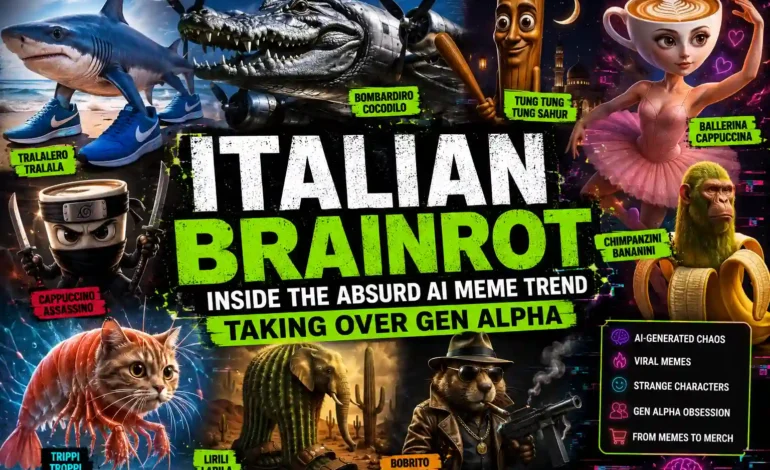
If you have spent any time on TikTok, Instagram, or YouTube Shorts in 2025 and 2026, chances are you have stumbled across a shark wearing sneakers, a crocodile fused with a bomber plane, or a ballerina with a coffee cup for a head. Welcome to the strange, chaotic, and oddly captivating world of Italian Brainrot — a meme phenomenon that has swept across social media, classrooms, toy aisles, and even video games in an astonishingly short amount of time.
What began as a handful of nonsensical AI-generated images has snowballed into a full-blown internet subculture, complete with its own mythology, family trees, rivalries, and merchandise empire. This article traces where the trend came from, introduces its strangest characters, examines why children are so drawn to it, and looks at the criticism and controversy that has followed in its wake.
What Exactly Is Italian Brainrot?
To understand Italian Brainrot, it helps to first understand “brainrot” itself. The term was named Oxford’s Word of the Year in 2024, and it describes the perceived decline of a person’s mental sharpness after consuming too much low-value, mindless online content. The word can refer either to that mental fog or to the content that causes it.
Italian Brainrot takes that idea and gives it a distinctly Italian-sounding twist. The trend consists of AI-generated characters, usually strange hybrids of animals mashed together with everyday objects, food, or weapons, given names that sound Italian even though they are largely invented gibberish. These characters are typically narrated in AI-generated Italian voiceovers that are just as nonsensical as the visuals, often layered with exaggerated, theatrical vocal delivery.
The names frequently borrow real Italian-style endings, such as “-ini,” “-ino,” or “-ella,” which makes them sound like plausible Italian words even when they mean nothing at all. Combine that with chaotic, oversaturated visuals and a complete absence of coherent storytelling, and you get content that is, by design, silly for the sake of being silly. There is no deeper message to decode — the absurdity itself is the entire joke.
How the Trend Began
Pinning down an exact origin story for Italian Brainrot is difficult, since it emerged organically from the TikTok meme community rather than being created by a single person. The earliest identifiable roots trace back to October 2023, when internet users began editing clips of actor and wrestler Dwayne Johnson into videos where he raps about absurd topics. One of these edits introduced a nonsense catchphrase that would later become foundational to the genre once it was paired with a crude Italian rhyme.
The character widely credited as the trend’s true starting point is Tralalero Tralala, a three-legged shark shown wearing designer sneakers. Its creation is often linked to a TikTok account that posted an early version of the character in January 2025, though that account was reportedly banned shortly afterward, likely due to profanity in the accompanying audio. From there, other creators began remixing the same audio clip with new AI-generated visuals — including a shark-pigeon hybrid and, eventually, a widely viewed video of a shark in shoes that helped push the meme into the mainstream.
From that point, the trend exploded. New creators kept inventing new hybrid creatures, each stranger than the last, and by early-to-mid 2025 “Italian Brainrot” had become a recognizable genre in its own right, spreading rapidly through TikTok, Instagram, and YouTube.
Meet the Characters
Italian Brainrot is less a single joke than an ever-expanding universe of characters, many of whom have developed their own recurring storylines, family relationships, and rivalries thanks to fan-made content. Here are some of the most well-known figures in the Brainrot canon.
Tralalero Tralala
The character that started it all: a three-legged shark sporting a pair of Nike sneakers. Fans have given him a backstory involving superhuman speed and jumping ability, along with an enthusiasm for gaming and a family of small shark children. He is widely regarded as the unofficial mascot of the entire trend.
Tung Tung Tung Sahur
An anthropomorphic wooden log that carries a wooden bat, Tung Tung Tung Sahur is technically an outlier in the Italian Brainrot family, since its roots are Indonesian rather than Italian. Its name imitates the rhythmic beating of a traditional slit drum, called a kentungan, which is used in Indonesia to wake people for suhoor, the pre-dawn meal eaten before the daily fast during Ramadan. In fan lore, the character appears if its wake-up call is ignored too many times, giving it a slightly ominous, almost cautionary-tale quality that sets it apart from the trend’s sillier entries. Despite its different origin, it has become one of the most recognizable faces of the broader meme and has spun off into its own standalone internet joke.
Bombardiro Crocodilo
A hybrid of a crocodile’s head and the body of a World War II-era propeller bomber plane, Bombardiro Crocodilo is one of the genre’s most theatrical characters, often depicted dropping bombs in over-the-top fashion. Fan lore gives him a sibling, a goose merged with a fighter jet, continuing the trend’s habit of building out extended, invented family trees for its characters.
Ballerina Cappuccina
A graceful ballerina whose head is a cappuccino mug, typically shown twirling in a tutu. Community-driven storytelling has expanded her into a full soap-opera figure: she is often described as married to a knife-limbed assassin whose head is also a coffee cup, though fan narratives frequently have her caught up in dramatic love triangles with other characters. She is also said to have a sister modeled after an espresso cup.
Chimpanzini Bananini
A chimpanzee whose body is a banana, often described by fans as nearly indestructible and considered one of the trend’s central figures.
Trippi Troppi
Depending on which corner of the internet you find it in, this character is either a cat with a shrimp’s body or a heavyset bear with a fish’s head — the latter version has earned an informal nickname among fans as a kind of ruler of the sea.
Lirili Larila
A bipedal hybrid of a cactus and an elephant, shown wearing sandals. Fan lore often portrays this character as a peaceful figure who avoids conflict unless pushed into it.
Cappuccino Assassino
The counterpart to Ballerina Cappuccina in fan storytelling, this character has a coffee-cup head and knife blades in place of limbs, and is typically portrayed as swift, lethal, and driven by a grudge against Bombardiro Crocodilo.
Bobrito Bandito
A beaver depicted as a small-time gangster, often shown smoking or engaging in petty crime — essentially a rodent version of a mafia film character, filtered through the same absurdist AI-generated lens as the rest of the trend.
Why Kids Can’t Get Enough of It
Italian Brainrot has found its most devoted audience among Generation Alpha, and child development experts have offered some insight into why. According to a neuropsychologist interviewed on the subject, this type of content is engineered — even if unintentionally — to deliver fast, high-reward bursts of stimulation without requiring sustained attention or effort. Combined with children’s natural pull toward novelty and silliness, that combination makes the format extremely sticky.
That same appeal, however, comes with a caveat. While brief or occasional exposure isn’t inherently damaging, experts note that heavy, repeated consumption of rapid-fire, low-substance content can shape developing brains in less desirable ways. Children accustomed to nonstop stimulation may find it harder to sit through slower-paced activities like reading, schoolwork, or even ordinary conversation. Potential effects include a shortened attention span, lower tolerance for boredom or frustration, and reduced capacity for sustained, deep thinking.
The general recommendation from experts isn’t an outright ban, but moderation — making sure screen time filled with this kind of rapid-fire content is balanced against real-world interaction and activities that require more patience and focus.
An Unlikely Language-Learning Tool?
Oddly enough, some educators and language enthusiasts have found a silver lining in all the nonsense: Italian Brainrot may double as an accidental gateway into learning actual Italian. Because the invented character names are built from real Italian phonetic patterns — open vowels, doubled consonants, and diminutive suffixes like “-ino” and “-ina” — repeating them out loud can help build the muscle memory needed for authentic Italian pronunciation.
Some of the words embedded in these names are, in fact, real Italian vocabulary (cappuccino and ballerina, for example), while others simply mimic the rhythm and structure of the language without carrying real meaning. Proponents argue that this kind of passive, repeated exposure — laughing at memes, scrolling, repeating the silly names — can plant the seeds of language pattern recognition without the pressure of a formal lesson, and might spark curiosity about Italian culture more broadly.
From Screens to Store Shelves
What makes Italian Brainrot particularly notable, compared to countless memes that flare up and vanish, is how quickly it jumped from purely digital content into physical, real-world products. Sticker collections modeled on the trend’s characters have been released by major collectible companies, quickly followed by trading card games built around a battle-style ruleset, similar to other collectible card games, where each character has its own stats.
The commercial expansion didn’t stop there. Coloring books, school supplies, backpacks, pencil cases, official character guidebooks, and touring live shows aimed at young children have all emerged around the trend. Brands across multiple industries have also borrowed the aesthetic for their own marketing campaigns, and the characters have inspired a wave of speculative cryptocurrency tokens as well as non-fungible token collections. The characters even became central to a wildly popular Roblox game built entirely around collecting and “stealing” Brainrot creatures from other players.
Read Also: The TikTok Rizz Party: How a Random Sweet 16 Video Became an Internet Sensation
The trend’s reach has extended into mainstream gaming, too — two of its best-known characters were added as purchasable skins in a major battle royale game in 2026, although the addition proved divisive, with at least one of the skins becoming notably unpopular among the game’s existing player base due to its AI-generated origins.
Global Reaction and Controversy
Italian Brainrot has attracted attention well beyond its core teenage and preteen audience, drawing commentary from media outlets across the United States, South Korea, Germany, France, Poland, and China, among other regions. Reactions have ranged from amused bewilderment to genuine concern.
Some commentators have embraced the trend as a creative, if chaotic, blend of technology, language, and youth culture. Others have raised more pointed criticisms — particularly around the trend’s habit of applying invented “Italian” branding to characters and audio that sometimes touch on real-world religious or political sensitivities, which some observers have called into question.
Two specific pieces of controversial audio have drawn particular scrutiny. The narration accompanying the original Tralalero Tralala character includes a blasphemous line about a major world religion; some Muslim TikTok users have objected to this, though others have pointed out that similar language is sometimes used casually as filler in colloquial Italian speech rather than as a deliberate insult. Separately, narration associated with Bombardiro Crocodilo references bombing children in a real active conflict zone, a joke that critics argue trivializes an ongoing humanitarian crisis and risks desensitizing young audiences to real-world violence.
There have also been comparisons drawn to past instances of unsettling AI- or algorithm-driven children’s content that slipped past parental oversight, with concerns raised in international press about the trend’s rapid, largely unsupervised spread among very young viewers.
Not the First of Its Kind
While Italian Brainrot feels distinctly like a product of the AI age, some observers have noted that the impulse behind it — collective, nonsensical, absurdist creativity — is far from new. Commentators have drawn loose comparisons to a range of earlier cultural touchstones: the whimsical, slightly unsettling digital assistant designs Microsoft commissioned in the 1990s as alternatives to its infamous paperclip mascot; the surrealist parlor game “exquisite corpse,” in which multiple artists blindly contributed to a single collaborative drawing nearly a century ago; medieval bestiaries filled with fantastical, often nonsensical hybrid creatures; the nihilistic, retro-digital aesthetic of the 2010s vaporwave art movement; and even a much older Italian trading card series from decades past featuring grotesque doll-like characters with similarly Italian-sounding, nonsense names.
None of these earlier phenomena directly inspired Italian Brainrot in any provable way — the current trend seems to have emerged largely from the unpredictable combination of AI image generation tools and internet meme culture. But the echoes are hard to ignore, suggesting that humanity’s appetite for collectively created absurdity is a recurring pattern rather than a brand-new invention of the algorithm age.
The Bottom Line
Italian Brainrot is, by almost any traditional measure, meaningless: invented names, nonsensical narration, and AI-generated visuals with no coherent plot. And yet that very meaninglessness appears to be the source of its power. It has captivated an entire generation of young internet users, spun off a sprawling merchandise industry, crossed over into mainstream video games, sparked genuine cultural debate, and even found unexpected use as an accidental language-learning tool.
Whether you see it as harmless, silly fun or as a symptom of a wider trend toward shorter attention spans and more disposable content, Italian Brainrot shows no signs of slowing down. New characters continue to appear, fan lore keeps expanding, and the line between internet joke and genuine cultural phenomenon keeps getting blurrier. Love it or hate it, it has secured its place — for now, at least — as one of the defining internet trends of the mid-2020s.