Research Dossier for Target Company: A Complete Guide for 2026
Introduction
A research dossier for a target company is more than a collection of website links, financial figures, screenshots, news articles, and copied company information. It is a structured report that explains how a business operates, what it sells, who its customers are, how it earns money, who controls it, how it compares with competitors, and what opportunities or risks may affect its future.
Company research is useful for many purposes. Investors may use it to evaluate a business before making a financial decision. Job candidates can investigate an employer before an interview. Sales teams can research potential customers before contacting decision-makers. Journalists, consultants, students, and business analysts may also need reliable information about a company.
However, useful research requires more than collecting information from the internet. Company websites usually present the organization in a positive way, while third-party sources may contain outdated figures, estimates, or unverified claims. A professional dossier compares these sources, checks important facts, records dates, and explains where information remains uncertain.
This guide explains how to prepare a company research dossier step by step. It covers company identity, business models, financial performance, products, leadership, competitors, market conditions, technology, legal issues, reputation, risk analysis, and source verification. It also explains how to organize findings into a report that supports better decisions.
What Is a Research Dossier for a Target Company?
A company research dossier is a structured document that combines verified information and analysis about a specific business. It provides a clear overview of the organization and helps readers understand its operations, position, background, and possible future direction.
The exact content depends on the research objective. A dossier prepared for a job interview may focus on leadership, workplace culture, products, and recent developments. A report prepared for investment research may require financial statements, debt levels, revenue growth, ownership information, and competitive risks. A sales dossier may focus on company size, decision-makers, business needs, technology, and potential buying opportunities.
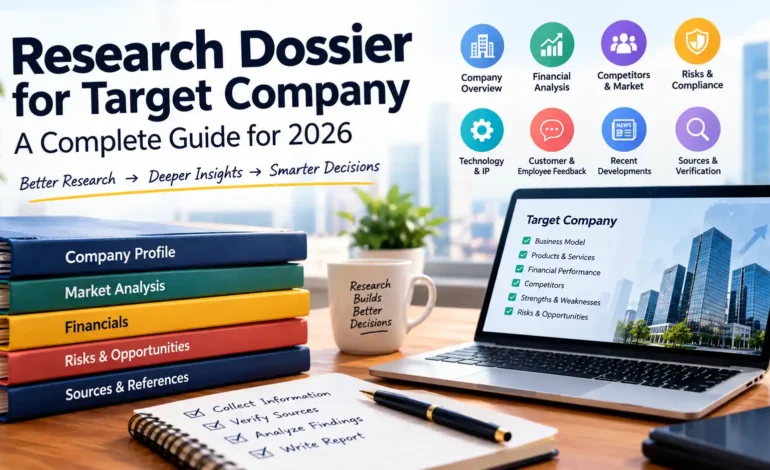
A typical company research dossier may include:
- Company identity, legal name, and registration details
- Company history and major milestones
- Products and services
- Business model and revenue sources
- Target customers and geographic markets
- Leadership, ownership, and parent-company relationships
- Financial performance and business economics
- Competitors and industry conditions
- Technology, operations, and intellectual property
- Recent news, acquisitions, and strategic changes
- Customer and employee feedback
- Legal, regulatory, and cybersecurity considerations
- Business risks, strengths, weaknesses, and opportunities
- Sources, verification notes, and unanswered questions
These sections should work together rather than exist as unrelated lists. For example, learning that a software company earns subscription revenue is useful, but the analysis becomes more valuable when it also explains which customers purchase subscriptions, why they continue paying, how the product compares with alternatives, and whether the company depends heavily on a small group of customers.
The goal is to turn scattered information into a reliable, understandable picture of the business.
Why Company Research Matters
Companies leave evidence across many different sources. Their official websites explain products and services. Government registers provide legal and registration details. Financial filings can reveal revenue, costs, debt, and risks. Patent databases may show intellectual-property activity. Job advertisements can offer clues about hiring priorities, while reputable news organizations may report acquisitions, lawsuits, product launches, or executive changes.
No single source usually tells the whole story. A company may publish a strong growth announcement without providing enough information to evaluate profitability. A third-party database may estimate its employee count, but the estimate may be based on incomplete information. Customer reviews may reveal recurring service complaints, yet they may not represent the experience of the entire customer base.
A research dossier helps bring these different pieces together. It allows the researcher to compare evidence, identify inconsistencies, and distinguish documented facts from opinions or assumptions.
Good company research can help answer practical questions:
- Is this the correct legal entity?
- What does the company actually sell?
- Who pays for its products or services?
- How does it make money?
- Who owns and manages the business?
- Which companies compete with it?
- What has changed recently?
- What risks could affect its operations?
- Which claims are supported by reliable evidence?
- What important information is still unavailable?
A dossier cannot eliminate all uncertainty, particularly when researching private companies. It can, however, make uncertainty visible and prevent unsupported assumptions from being presented as facts.
Step 1: Define the Purpose of the Research
Before collecting information, decide why the dossier is being prepared. This is one of the most important steps because the objective determines which information deserves the most attention.
Start by writing a simple statement:
“This dossier is being prepared to understand [research subject] for the purpose of [intended decision].”
This statement creates a clear boundary for the research. Without it, the process can become an endless search for information that does not contribute to the final objective.
Research for Employment
Someone preparing for a job interview may need to understand the company’s products, recent announcements, leadership, competitors, workplace culture, and financial stability. They may also want to know how the department fits into the organization and what challenges the company is currently addressing.
For this purpose, a long analysis of every financial metric may be unnecessary. Recent business developments and the responsibilities of the hiring department may be more useful.
Research for Sales and Business Development
A salesperson researching a prospective customer should focus on company size, locations, decision-makers, business model, existing technology, expansion plans, and operational challenges.
The objective is not simply to learn basic company facts. It is to identify whether the organization has a genuine need that the salesperson’s product or service can address. Any sales opportunity should be based on reasonable evidence rather than assumptions about the company’s problems.
Research for Investment
Investment-focused research requires closer attention to financial statements, revenue growth, margins, operating cash flow, debt, capital expenditure, ownership, market position, and competitive pressure.
The researcher should examine multiple reporting periods instead of relying on one financial result. Strong revenue growth, for example, does not automatically mean a company is profitable or financially secure.
Research for Journalism or Academic Work
Journalists and students may need a broader historical view, including company origins, leadership changes, public statements, regulatory records, industry context, and credible independent reporting.
In these cases, careful sourcing is essential. Claims should be supported by appropriate evidence, and allegations should not be presented as proven facts unless the available records justify that conclusion.
Step 2: Confirm the Company’s Identity
Before analyzing a company, make sure you are researching the correct organization. Businesses may operate under a brand name that differs from their legal name. A parent company may own several subsidiaries, while different companies in different countries may use similar names.
Confusing these entities can lead to serious errors. Financial figures might belong to the parent company rather than the target business. A lawsuit may involve a subsidiary, while a product may be owned by another organization entirely.
Record the following details when available:
- Legal company name
- Trading or brand name
- Official website
- Registration number
- Country and state of incorporation
- Registered office or headquarters
- Parent company and known subsidiaries
- Main operating locations
- Industry and primary business activity
- Current leadership, with the date checked
Use Government and Regulatory Records
Government registries and regulatory filings can help confirm company identity and legal status. The appropriate source depends on the company’s country and legal structure.
In the United States, the Securities and Exchange Commission’s EDGAR system provides public access to filings submitted by companies and other regulated entities. It is particularly useful when researching publicly reporting companies.
In the United Kingdom, Companies House provides public records for registered companies, including information such as incorporation details, submitted accounts, officers, and filing history. The amount of information available depends on the organization and its filing obligations.
Other countries maintain their own company registers, securities regulators, and official databases. Use the relevant national source whenever possible.
A commercial company database can help you discover a registration number or possible parent company, but important identity claims should be checked against authoritative records where available.
Distinguish Legal Identity from Brand Identity
A brand name does not always reveal the legal structure behind a business. For example, a product may be marketed under one name but sold by a subsidiary that belongs to a larger corporate group.
Record these relationships clearly. If a financial statement covers the entire group, do not describe the figures as belonging only to one subsidiary unless the document provides that breakdown.
Also check whether the company is active, dissolved, renamed, merged, or subject to another legal change. A website that remains online does not necessarily prove that the registered company is still operating.
Step 3: Review the Official Company Website
The official website is usually the best starting point for understanding what a company says about itself. It can provide product descriptions, service information, pricing, contact details, leadership biographies, career opportunities, press releases, security policies, and investor materials.
Review the following pages where available:
- About Us
- Products and Services
- Pricing
- Leadership or Management
- Investor Relations
- Careers
- Newsroom and Press Releases
- Product Documentation
- Security and Compliance
- Contact Information
- Terms of Service and Privacy Policy
Do not assume that every statement on the website is independently verified. Company websites are designed to communicate with customers, investors, employees, and other audiences. Marketing language may emphasize strengths while providing limited detail about weaknesses or uncertainty.
Pay particular attention to descriptions such as “the market leader,” “the fastest-growing,” “the most secure,” “trusted by thousands,” or “the world’s largest.” These phrases may be promotional claims rather than independently established facts.
Record the claim, identify who made it, and look for supporting evidence. If a company says its product serves a large number of customers, for example, check whether it provides a date, a clear definition of a customer, and any independent confirmation.
The website is a source of information, but it should not automatically become the final authority for every conclusion in the dossier.
Step 4: Build a Reliable Source Hierarchy
Not all sources have the same evidential value. A professional dossier should prioritize sources according to the claim being investigated.
Primary Sources
Primary sources provide information directly from the organization or an official institution. Examples include regulatory filings, government records, court documents, patent records, annual reports, official financial statements, product documentation, and company announcements.
These sources are often the strongest starting point for specific factual questions. However, a primary source must still be interpreted correctly. A company press release can verify that the company announced a product, but it may not independently establish that the product achieved commercial success.
Strong Secondary Sources
Secondary sources include established news organizations, specialist industry publications, reputable research organizations, and professional financial publications.
These sources can add independent context, explain market developments, and report information that is not available in official company documents. Check the publication date, the author’s expertise, the evidence cited, and whether the report distinguishes confirmed information from speculation.
Informal Sources
Informal sources include online forums, social media posts, review platforms, anonymous comments, and discussion communities.
These sources can help identify questions worth investigating. Several customers discussing the same product issue, for example, may suggest a topic for further research. However, informal comments may be incomplete, biased, outdated, or difficult to verify.
Use them as research leads rather than definitive proof. Multiple websites repeating the same unsupported statement do not necessarily provide independent confirmation.
Match the Source to the Claim
The most useful source depends on the question. A government registry is generally better for confirming a company’s registration than a social media profile. A technical manual may be more useful for verifying a product feature than a marketing blog. A court record is more appropriate for checking the procedural status of a lawsuit than an unsourced news summary.
This approach improves accuracy and makes the dossier easier for another person to review.
Step 5: Understand the Company’s Business Model
A company’s business model explains how it creates value for customers and converts that value into revenue. This section should go beyond a general statement such as “the company provides technology solutions.”
Start by identifying who pays the company. Its customers may include individual consumers, small businesses, large enterprises, governments, advertisers, distributors, developers, or financial institutions.
Next, determine what customers are purchasing. A business might sell physical products, software subscriptions, professional services, advertising space, transaction processing, licenses, data access, cloud infrastructure, memberships, or marketplace services.
Then examine how and when customers pay. Common revenue models include:
- Monthly or annual subscriptions
- One-time product purchases
- Usage-based billing
- Transaction fees
- Commission on sales
- Licensing agreements
- Advertising revenue
- Consulting or service fees
- Contract-based enterprise payments
A company may use several models at once. For example, a software provider might offer basic subscriptions, charge additional fees for premium support, and generate extra revenue from usage-based services.
Understand Why Customers Keep Paying
Revenue depends not only on attracting customers but also on retaining them. Investigate what encourages customers to continue using the company’s products or services.
Possible reasons include product quality, reliable support, useful integrations, long-term contracts, accumulated customer data, employee familiarity, network effects, and the cost or difficulty of switching to another provider.
These factors can help explain the durability of a business model. A subscription company with strong retention may have more predictable recurring revenue than a company that depends mainly on occasional purchases. However, recurring billing alone does not guarantee customer loyalty or profitability.
Examine Distribution and Sales Channels
Also identify how the company reaches customers. It may sell directly through its website, use a sales team, work with distributors, operate through app stores, rely on retail partners, or sell through a marketplace.
Distribution affects costs, customer access, and control over the sales process. A company that depends heavily on one platform or distributor may face additional risk if fees increase or the relationship changes.
A useful business model section should therefore explain what is sold, who pays, how payment works, how customers are reached, and why the relationship may continue over time.
Step 6: Examine Business Economics and Key Metrics
Business economics help explain whether a company’s model can support sustainable operations. The relevant metrics depend on the industry, but the researcher should understand the relationship between revenue, costs, customer acquisition, retention, and cash flow.
For example, imagine a software provider charges $20 per user per month and a customer has 50 paid users. The basic annualized subscription value is:
50 users × $20 × 12 months = $12,000 per year
This calculation provides a simple illustration of potential annual revenue from that account. It does not prove that the company will collect exactly $12,000. Discounts, refunds, contract terms, user changes, taxes, and cancellations can affect the actual amount.
Useful metrics may include:
Revenue: The income generated from selling products or services before deducting expenses.
Gross margin: The portion of revenue remaining after the direct costs associated with delivering products or services.
Operating expenses: Costs such as salaries, marketing, research and development, rent, administration, technology, and professional services.
Operating income: A measure of profitability from core operations after operating expenses.
Operating cash flow: Cash generated or used by the company’s operating activities.
Free cash flow: A measure commonly calculated by subtracting capital expenditures from operating cash flow.
Customer acquisition cost (CAC): The average cost of acquiring a customer, based on the costs and customer count included in the calculation.
Customer lifetime value (LTV): An estimate of the economic value a customer generates over the relationship with the business.
Churn: The rate at which customers or recurring revenue are lost over a period.
These measures are especially relevant to subscription and technology companies, but they must be interpreted in context. Different companies may calculate similar metrics differently, so check definitions before comparing results.
A company with rapid revenue growth may still face cash-flow pressure if its operating costs rise faster than income. A slower-growing business may be financially resilient if it maintains healthy margins, controlled expenses, and consistent cash generation.
Read also: Top SEO Strategies to Scale Your Business Growth
Step 7: Map Products and Services
Create a structured overview of the company’s products and services instead of relying on a long, general description. For each major offering, record its purpose, intended customer, pricing or revenue model, and the source used to verify the information.
| Product or service | What to investigate |
| Core product | Main problem it solves and primary customer |
| Additional products | Whether they expand the company’s offering |
| Professional services | Consulting, implementation, or support provided |
| Enterprise offering | Features and terms for larger organizations |
| API or developer tools | Integrations and usage-based opportunities |
| Discontinued products | Evidence of product changes or strategic shifts |
Product documentation can be especially valuable because it may describe actual features, technical limitations, integrations, and requirements more precisely than a marketing page.
Investigate whether products are available in every market, whether pricing is public, and whether features differ between customer plans. If the company serves multiple customer segments, explain how the products differ for consumers, small businesses, and enterprise buyers.
Also review discontinued products. A product being removed does not automatically mean it failed. It may have been replaced, consolidated into another offering, affected by a regulatory change, or removed as part of a strategic shift. Document what happened and avoid claiming a reason unless reliable evidence supports it.
Step 8: Research Leadership and Ownership
Leadership and ownership research helps explain who makes decisions, who controls the business, and how responsibility is organized. Depending on the company, relevant people may include the founder, chief executive officer, chief financial officer, chief technology officer, chief operating officer, board members, major shareholders, institutional investors, and parent-company executives.
Do not assume the CEO is the only person who matters. A technology company may depend heavily on its technical leadership, while a regulated financial business may have important compliance executives. For a subsidiary, parent-company leadership may influence budgets, product decisions, and strategy.
For public companies, regulatory filings can provide information about executive compensation, major shareholders, and certain ownership relationships. For private companies, ownership details may be more difficult to establish. Business databases can provide useful leads, but significant ownership claims should be verified through reliable records whenever possible.
Record the date on which leadership information was checked. A biography page may remain online after an executive leaves, so a current title should not be accepted without checking for more recent evidence.
It is also useful to distinguish between founders, executives, board members, investors, and legal owners. These roles can overlap, but they are not interchangeable. A founder may no longer manage the company, while an investor may hold an ownership stake without controlling daily operations.
Step 9: Build a Company Timeline
A timeline shows how the business developed and helps explain its current position. Instead of listing every minor announcement, focus on milestones that changed the company’s operations, ownership, products, markets, or strategy.
Relevant events may include:
- Company formation and early funding
- Launch of a major product
- Entry into a new geographic market
- Significant investment or financing
- Acquisition or merger
- Leadership changes
- Major partnership agreements
- New business lines
- Office closures or restructuring
- Regulatory decisions or important legal events
A timeline can reveal patterns that are less obvious in ordinary paragraphs. Repeated acquisitions may indicate an expansion strategy. A sequence of new enterprise products may suggest a shift toward larger customers. Hiring growth in one region alongside office closures in another may indicate an operational change.
Use dates from reliable sources and distinguish between the date an event was announced and the date it actually occurred. An acquisition, for example, may be announced in one year and completed in the next after regulatory approval.
A simple timeline table can include the date, event, source, and significance. The significance column should explain why the event matters instead of merely repeating the announcement.
Step 10: Identify and Compare Competitors
Competitor research should explain which alternatives customers can choose and why those alternatives matter. A weak dossier simply lists well-known companies in the same industry. A stronger one shows how products, customers, pricing, distribution, and business models overlap.
Begin with the target company’s core offering. What problem does it solve? Who buys it? Which other products could solve the same problem? How difficult would it be for customers to switch?
Competitors generally fall into several categories:
Direct competitors offer similar products or services to similar customers.
Indirect competitors address the same customer need through a different approach.
Substitute solutions may include manual processes, spreadsheets, internal tools, or services that customers use instead of purchasing the target company’s product.
New entrants are businesses that could enter the market and compete for customers.
Established incumbents are larger or longer-running organizations that may have stronger distribution, brand recognition, or financial resources.
For example, a cloud accounting company may compete with other accounting platforms, traditional desktop software, banking services that include accounting features, or spreadsheets used by very small businesses.
Build a comparison table that examines meaningful factors such as target customer, pricing, product capabilities, integrations, customer support, geographic availability, and distribution. Use evidence for each comparison and note where pricing or features are not publicly available.
The purpose is not to declare a universal winner. It is to explain where the target company is positioned, which alternatives matter most, and what evidence supports the comparison.
Step 11: Examine Market Position and Competitive Pressure
After identifying competitors, examine the broader market in which the company operates. A business may have a strong product but still face challenges because the market is shrinking, customers are becoming more price-sensitive, or new competitors are entering.
Consider the following questions:
- Is the market dominated by a few large companies or divided among many smaller businesses?
- Are customers able to switch providers easily?
- Are new competitors entering the industry?
- Are alternative products becoming more attractive?
- Are suppliers gaining more bargaining power?
- Is the market growing, stable, or declining?
- Are regulations changing how businesses operate?
- Is the industry experiencing consolidation through mergers and acquisitions?
Market structure can influence pricing, profitability, and long-term growth. For example, a business operating in a highly competitive market may need to spend more on marketing or reduce prices to attract customers. A company serving a specialized market may face less direct competition but have fewer potential customers.
Look for reliable industry reports, government statistics, company filings, trade publications, and other evidence relevant to the market. Check how market size is defined and which geographic area and time period the figures cover. Estimates from different research providers may not be directly comparable because they can use different methods.
Market share also requires careful interpretation. A company may have a large share of a narrow product category but a small share of the broader industry. Always explain the market definition before presenting a market-share estimate.
The objective is to understand the pressures affecting the company rather than simply repeating claims about its industry position.
Step 12: Analyze the Company’s Financial Health
Financial research is especially important when investigating public companies or businesses that disclose reliable financial information. It helps explain whether the company is growing, generating profits, managing debt, and producing enough cash to support its operations.
Revenue is an important starting point, but it should not be the only measure considered. A company can increase sales while losing money if expenses rise faster than revenue. Another business may grow more slowly but generate strong cash flow and maintain a manageable cost structure.
Review the following measures where data is available:
- Revenue and year-over-year growth
- Gross profit and gross margin
- Operating expenses and operating income
- Net income or loss
- Operating cash flow
- Free cash flow
- Cash and cash equivalents
- Debt and interest expenses
- Capital expenditure
- Accounts receivable
- Share count and stock-based compensation
- Significant acquisitions and other unusual costs
Compare Multiple Reporting Periods
A single quarter may not provide a complete picture of financial performance. Compare several years of annual reports and, where useful, recent quarterly results.
Look for consistent patterns. Is revenue growing steadily or depending on one unusual contract? Are margins improving? Is the company spending more to acquire customers? Is debt increasing? Does the company generate cash from its normal operations, or does it rely on financing to cover expenses?
Seasonality also matters. A retailer may earn a large proportion of its annual revenue during holiday periods. A construction business may experience uneven revenue because of project schedules. Comparisons should account for these differences when possible.
Read Financial Statements Together
The income statement, balance sheet, and cash flow statement answer different questions.
The income statement shows revenue, expenses, and reported profit or loss over a period. The balance sheet shows assets, liabilities, and equity at a particular date. The cash flow statement explains how cash moves through operating, investing, and financing activities.
Read them together. Reported profit does not necessarily mean the company collected the same amount in cash. Similarly, a large cash balance may need to be evaluated alongside debt obligations, future commitments, and the company’s rate of cash consumption.
For private companies, financial information may be limited. Third-party databases may provide revenue or valuation estimates, but such figures should be labeled as estimates unless supported by reliable disclosures. Do not present an estimated private-company revenue figure as an official result.
Step 13: Investigate Intellectual Property and Patents
Intellectual property can be an important part of a company’s competitive position. Patents, trademarks, copyrights, and trade secrets may help protect technology, product designs, brand identity, software, or specialized processes.
Start by identifying the types of intellectual property relevant to the business. A technology company may hold patents for technical inventions. A consumer brand may depend more heavily on trademarks and product design. A software business may rely on copyrighted code, proprietary data, licenses, and trade secrets.
Patent databases can help researchers identify applications, granted patents, inventors, ownership information, and the general subject matter of an invention. In the United States, the United States Patent and Trademark Office provides patent-related search resources. Other countries and international systems provide additional records.
However, a patent count should not automatically be treated as a measure of innovation or commercial strength. Some patents may be more valuable than others, and a patent does not necessarily prove that a product is commercially successful. Applications may also be pending, rejected, expired, or assigned to another owner.
Record the relevant patent or trademark identifier, owner, status, filing date, and any available connection to the company’s products. Where possible, check whether the intellectual property belongs to the target company, a subsidiary, a founder, or a third party.
Also investigate licensing relationships and potential disputes when reliable information is available. A company may depend on technology it licenses from another organization, creating costs or operational risks if the agreement changes.
Step 14: Research the Company’s Technology and Operations
Technology and operational research can reveal how a business delivers its products and where it may depend on external providers. This section is particularly important for software companies, online platforms, digital services, and businesses whose operations rely heavily on technology.
Investigate publicly documented information about:
- Core software or technical products
- Cloud infrastructure and hosting arrangements
- Product integrations and APIs
- Data storage and processing
- Distribution systems
- Manufacturing or supply-chain dependencies
- Customer support operations
- Technical documentation
- Reliability and service availability
- Publicly disclosed technology partnerships
Do not assume that a technology used on a company website represents its entire internal technology stack. Public website technology detectors can identify some visible tools, but they generally cannot confirm every backend system, internal application, or operational dependency.
Job advertisements may provide additional clues. A company hiring for cloud engineering, data infrastructure, cybersecurity, or machine learning roles may be investing in those areas. However, a job listing is evidence of a hiring requirement, not proof that the company has completed a particular technology project.
Technology research should also consider resilience. Does the company depend on one cloud provider, payment processor, distributor, or critical software supplier? Would an outage or contract change disrupt its operations?
For manufacturers and product-based companies, examine supply-chain concentration, production locations, key suppliers, shipping arrangements, and exposure to material shortages where evidence is available.
The purpose is to identify how the business functions, which capabilities are important, and where operational dependencies could create problems.
Step 15: Evaluate Cybersecurity and Data Protection
Cybersecurity deserves particular attention when a company collects personal information, processes payments, stores sensitive business data, or operates digital infrastructure.
Start with public information, such as the company’s privacy policy, security documentation, data-processing terms, compliance statements, and published incident notices. These documents may explain what types of data the company collects, how it uses that data, and which security or compliance practices it publicly describes.
Look for credible reporting or official notices about security incidents, regulatory actions, data breaches, or service disruptions. Confirm the date, the source, and the actual scope of the event. A reported vulnerability does not necessarily mean that attackers exploited it, and an incident affecting one product does not automatically establish that every company system was compromised.
For businesses that provide security documentation, review the stated scope and date of any audit, certification, or assessment. A certification may apply to particular systems or operations rather than the entire organization.
Frameworks such as the NIST Cybersecurity Framework 2.0 can help organize questions about governance, identification of risks, protection, detection, response, and recovery. Using a framework to structure research does not mean the researcher has completed a formal security audit.
Avoid making technical claims that cannot be supported by public evidence. A responsible dossier might state that the company has published a security policy but that independent information about its internal security controls is limited.
The aim is to document visible risks and available evidence, not to claim certainty about systems that cannot be independently examined.
Step 16: Review Legal and Regulatory Issues
Legal and regulatory research can help identify events that may affect a company’s costs, operations, reputation, or ability to serve customers.
Potential areas include:
- Lawsuits and court proceedings
- Regulatory investigations
- Government enforcement actions
- Product recalls
- Licensing requirements
- Employment disputes
- Intellectual-property claims
- Consumer-protection issues
- Privacy and data-protection obligations
- Industry-specific compliance requirements
Use official court records, regulator announcements, company filings, and reliable reporting whenever possible. A news article can help identify a case, but the underlying record may provide more precise information about its status.
Most importantly, distinguish between an allegation, a filed lawsuit, an investigation, a settlement, a court ruling, and a final judgment. These are different legal situations.
A lawsuit does not automatically prove that the defendant committed wrongdoing. An investigation does not necessarily result in enforcement action. A settlement may resolve a dispute without establishing every allegation as true.
Record the parties involved, the relevant date, the issue being disputed, the procedural status, and any documented outcome. If the case remains unresolved, say so clearly.
Regulatory requirements also vary by industry and country. A financial services provider may face different obligations from a clothing retailer or software company. Identify the rules relevant to the target business rather than assuming every regulation applies equally.
A balanced legal section should describe verified events and explain their potential significance without exaggerating what the evidence establishes.
Step 17: Analyze Customer and Employee Feedback
Customer reviews and employee feedback can provide useful clues about how a company’s products and workplace are experienced in practice. They can help identify recurring themes that may not appear in official company materials.
For customer research, look for repeated comments about:
- Product quality and reliability
- Ease of use
- Pricing and value
- Customer service
- Delivery and fulfilment
- Technical support
- Billing and cancellation
- Product limitations
- Refunds or warranty experiences
For employee feedback, recurring topics may include management, workload, career development, compensation, workplace culture, communication, and organizational stability.
Do not treat every review as a verified account. Reviews may be genuine, mistaken, exaggerated, selective, or influenced by unusual experiences. People who post reviews may not represent the full customer or employee population.
Look for patterns across multiple independent sources and different time periods. A large number of recent, similar complaints may deserve more attention than one isolated comment. Even then, explain the limitations of the evidence.
Check whether feedback relates to the target company itself, a subsidiary, a particular location, or a specific product. A problem reported by users of one product may not reflect the quality of the company’s other offerings.
A balanced analysis should include both positive and negative themes. It should also distinguish between customer dissatisfaction, employee opinion, and independently verified operational problems.
Step 18: Search for Recent Company News
Company research can become outdated quickly. Leadership, products, financial performance, ownership, and strategic priorities may change within months.
After reviewing the company’s background, conduct a separate search for recent developments. Useful search combinations include:
- Company name plus acquisition
- Company name plus lawsuit
- Company name plus product launch
- Company name plus layoffs
- Company name plus partnership
- Company name plus expansion
- Company name plus executive
- Company name plus regulatory issue
- Company name plus security incident
Do not copy search headlines directly into the dossier. Open the underlying report and determine what actually happened, when it happened, who reported it, whether it was confirmed, and what changed afterward.
Distinguish between an announcement and a completed event. A company may announce a planned acquisition that is later delayed or cancelled. A product may be introduced in one market before becoming available elsewhere. A proposed regulation may not yet be in force.
Pay attention to publication dates and the dates of the events being reported. An article published recently may describe an event from several years earlier. Similarly, an older report may remain relevant if the issue has not been resolved, but its current status should be checked.
Recent news should be used to update the company’s timeline and identify changes that may affect the overall assessment.
Step 19: Separate Verified Facts, Company Claims, and Analysis
One of the most important disciplines in company research is keeping facts, claims, and interpretations separate.
Verified Facts
A verified fact is supported by reliable evidence appropriate to the statement. For example, an official filing may confirm that a company submitted an annual report on a particular date.
The wording should remain close to what the evidence establishes. If a filing reports revenue for a specific financial year, do not imply that the same figure represents current-year revenue.
Company Claims
A company claim is a statement made by the organization itself. For example, the company may state that its product serves thousands of customers or that a new service is designed for enterprise clients.
The claim can be reported accurately without treating it as independently verified. Use wording such as “the company states,” “according to its website,” or “the company announced.”
Analysis
Analysis is an interpretation based on evidence. For example, a series of enterprise-focused product launches may suggest that the company is placing greater emphasis on larger customers.
That conclusion may be reasonable, but it is still an interpretation unless the company has explicitly confirmed the strategy. Explain the evidence behind the conclusion and acknowledge alternative explanations where appropriate.
Keeping these categories separate makes the dossier more transparent. Readers can understand which statements are documented, which come from the company, and which represent the researcher’s judgment.
Step 20: Date-Stamp Important Information
A fact without a date can become misleading. Employee counts, executive positions, customer totals, revenue, office locations, and product availability can all change.
Instead of writing “the company has 10,000 employees,” identify the source and its reporting date. A more precise statement would explain that the figure was reported by the company as of a specified date or appeared in a particular filing.
Record at least the following dates when relevant:
- Date the event occurred
- Date the information was published
- Date the source was accessed
- Reporting period covered by financial information
- Date the company last confirmed the relevant detail
These dates serve different purposes. A news article may be published after an event, while a financial report may cover a period that ended months before publication.
Date-stamping makes future updates easier because researchers can identify which details need to be checked again. It also helps prevent old information from being presented as current.
Step 21: Create an Evidence Matrix
An evidence matrix connects important claims to their sources and verification status. It is one of the most practical ways to improve the quality of a company research dossier.
A basic matrix may contain these columns:
| Claim or finding | Source | Source type | Date | Status | Notes |
| Company founded in 2016 | Corporate registry | Primary | Date checked | Verified | Consistent with records |
| Company has 50,000 customers | Company website | Company claim | Date checked | Unverified | No independent count found |
| Product launched in 2025 | Company announcement and news | Mixed | 2025 | Confirmed | Two sources support event |
| Major security issue | Online review or forum | Informal | Date posted | Needs verification | Further evidence required |
The entries above are illustrative examples, not claims about a particular company.
An evidence matrix helps identify gaps. If a major conclusion relies on one weak source, the researcher can seek better evidence before finalizing the report. If two sources disagree, the discrepancy can be investigated rather than hidden.
It also improves collaboration. Another analyst can see where a finding came from and understand why it was included.
Step 22: Assign Confidence Levels to Important Findings
A confidence rating gives readers a quick indication of how strongly a finding is supported. It should reflect the quality and consistency of evidence rather than how convincing the claim sounds.
High confidence: A primary source directly establishes the fact, or multiple strong and independent sources agree.
Medium confidence: A credible source supports the claim, but independent confirmation is limited or some details remain uncertain.
Low confidence: The claim depends mainly on informal comments, third-party estimates, indirect evidence, or incomplete records.
For example, a legal company name confirmed by an official registry may receive high confidence. An estimated website traffic figure from a commercial tool may receive medium confidence because measurement methods differ. An anonymous allegation without corroboration should receive low confidence.
Confidence ratings should not be confused with the importance of a finding. A low-confidence allegation may still require investigation if the potential consequences are serious. The correct response is to flag the uncertainty, seek additional evidence, and avoid presenting the allegation as established fact.
Step 23: Investigate Contradictions and Negative Information Fairly
A strong dossier should not become a promotional brochure. It should investigate credible negative evidence as carefully as positive information.
Potential concerns include lawsuits, regulatory actions, product recalls, cybersecurity incidents, executive departures, layoffs, customer complaints, supply-chain problems, financial distress, and reputational controversies.
However, negative claims require careful handling. Repetition does not automatically make an allegation true. Several low-quality websites may copy the same original statement without independently checking it.
Look for contradictions between company statements and other evidence. For example, a business may describe its operations as global, while its public financial disclosures show that most reported revenue comes from one region. An executive listed on an old website may no longer hold that position. A product described as widely adopted may have limited publicly documented customer evidence.
Do not immediately assume that the company has misled people. Differences may result from reporting periods, definitions, regional variations, outdated pages, or confusion between a parent company and a subsidiary.
Document the competing claims, compare their sources, and explain what can and cannot be established. If a contradiction remains unresolved, identify it as an open question rather than forcing a conclusion.
Step 24: Identify the Company’s Main Business Risks
A professional research dossier should include a dedicated risk section. Risks are not proof that a company will fail; they are factors that could affect its performance, operations, reputation, or future opportunities.
Common categories include:
Market risk: Customer demand may weaken, market growth may slow, or the target market may shrink.
Competitive risk: Competitors may introduce better products, lower prices, stronger distribution, or more attractive customer experiences.
Financial risk: High debt, persistent losses, weak cash flow, or limited access to financing may reduce the company’s flexibility.
Regulatory risk: New rules, enforcement actions, or licensing requirements may increase costs or restrict operations.
Technology risk: Products may become outdated, systems may fail, or new technology may make existing offerings less attractive.
Cybersecurity risk: Data breaches, service interruptions, or weak security practices may create financial and reputational damage.
Customer concentration risk: Heavy dependence on a small number of customers can make revenue vulnerable if a major contract is lost.
Supplier risk: Reliance on one supplier, distributor, cloud provider, or manufacturing location may create operational exposure.
Reputation risk: Negative public sentiment, poor service, or unresolved complaints may affect customer acquisition and partnerships.
For each risk, record the evidence, possible business impact, and degree of uncertainty. Where possible, consider whether the company has disclosed measures to manage the risk.
Avoid describing every possible problem as a confirmed weakness. A useful risk assessment distinguishes documented issues from plausible exposures that require further investigation.
Step 25: Summarize Findings with a SWOT Analysis
A SWOT analysis organizes the main findings into strengths, weaknesses, opportunities, and threats. It is useful as a summary, but it should be based on evidence collected elsewhere in the dossier.
| Category | Questions to consider |
| Strengths | What capabilities, products, relationships, or resources support the business? |
| Weaknesses | What internal limitations or dependencies could restrict performance? |
| Opportunities | Which markets, products, partnerships, or customer needs could support growth? |
| Threats | Which external changes, competitors, regulations, or economic conditions could create challenges? |
Potential strengths might include recurring revenue, a recognized brand, loyal customers, proprietary technology, or established distribution. Potential weaknesses could include high operating costs, customer concentration, limited geographic reach, or dependence on one product.
Opportunities may include new markets, partnerships, product development, or increased demand for an existing service. Threats may include stronger competitors, technology disruption, changing regulations, or an economic downturn.
These are examples, not universal conclusions. A company should not be described as having strong customer loyalty merely because it has many customers. Evidence such as retention data, repeat purchases, contract renewals, or credible customer research would make the conclusion stronger.
SWOT should summarize the analysis, not replace it. Each major point should connect to a source or finding elsewhere in the report.
Step 26: Investigate Customers and Customer Needs
Understanding customers helps explain why a company exists and how it competes. Start by identifying the primary customer groups, the problems they face, and the reasons they might choose the target company over alternatives.
Customers may differ by company size, industry, income level, location, technical requirements, or purchasing process. A software business, for example, may sell a simple self-service product to individuals while offering custom contracts and implementation support to large enterprises.
Investigate publicly available customer case studies, product examples, testimonials, partner announcements, and contract disclosures. Be careful when interpreting customer lists: being named as a customer does not necessarily mean that the relationship is current, large, or commercially significant.
Where evidence exists, examine customer concentration. A company that depends on a few major accounts may face greater exposure if one relationship ends. A business with a broad customer base may be less dependent on individual contracts, although it may face other challenges such as higher marketing costs or greater churn.
Also consider why customers might switch to another provider. Price, poor service, product limitations, integration difficulties, changing business needs, and better competing products can all influence retention.
The goal is to understand the customer relationship in practical terms rather than simply repeating the company’s target-market description.
Read also: Target Company URL Research: A Practical Guide to Finding Official Business Websites
Step 27: Review Hiring Trends and Organizational Changes
Hiring information can provide clues about a company’s priorities, but it should be interpreted carefully. A business advertising roles in cybersecurity, sales, international operations, or artificial intelligence may be investing in those capabilities. Yet job advertisements alone do not prove that a new initiative has been approved or successfully implemented.
Compare current job listings with older listings where available. Look at the types of roles being advertised, the departments involved, the locations named, and the skills requested.
A rise in sales and customer-success roles may be consistent with an expansion effort. Hiring for compliance or security positions may indicate a need to strengthen internal capabilities. However, these patterns can have several explanations, including routine replacement hiring or organizational restructuring.
Also review reliable reports of layoffs, office closures, leadership departures, and reorganizations. Confirm whether an announcement applies to the entire company, a specific department, or a particular country.
Avoid drawing sweeping conclusions from a single vacancy or employee comment. Hiring trends become more informative when combined with company announcements, financial disclosures, and other evidence.
Step 28: Research Geographic Expansion and Acquisitions
Geographic expansion can help a company reach new customers, but it may also introduce additional costs, regulatory requirements, and operational complexity.
Check which markets the company serves and distinguish between having a website accessible in a country and having a meaningful local operation there. Evidence of local offices, employees, distribution partners, regulatory registrations, or regional financial disclosures may provide a clearer picture.
For acquisitions, investigate more than the announcement. Record the date announced, completion date, disclosed purchase price, strategic purpose, acquired products or technology, leadership changes, and subsequent integration activity.
An acquisition may provide customers, talent, intellectual property, geographic reach, distribution, or new capabilities. It may also create integration costs, organizational complexity, or overlapping products.
Do not assume an acquisition succeeded simply because it was completed. Look for later evidence showing whether the acquired product remains available, whether the business was integrated, and whether the buyer disclosed relevant outcomes.
When the purchase price or strategic rationale is not public, state that the information could not be verified. Avoid filling gaps with speculation.
Step 29: Examine Discontinued Products and Brand Reputation
Discontinued products may reveal changes in company priorities. A product might be removed because of weak demand, high development costs, product consolidation, regulatory changes, acquisition integration, or replacement by a newer offering.
The discontinuation itself may be verifiable, while the reason may remain uncertain. Use company announcements, product documentation, customer notices, and credible reporting to establish what happened. Do not automatically label a discontinued product a failure.
Brand reputation should also be examined through several types of evidence. Consider customer feedback, employee reviews, industry discussion, news coverage, product forums, and the company’s own public responses.
Look for repeated themes involving price, reliability, product quality, support, transparency, workplace culture, or ease of use. Compare positive and negative evidence and note whether the themes are recent or historical.
A star rating by itself is not enough to establish a company’s overall reputation. Review volume, timing, reviewer context, and recurring issues all matter. A balanced assessment explains the available evidence and its limitations.
Step 30: Avoid Common Company Research Mistakes
Even a detailed dossier can be unreliable if the researcher makes basic errors. The following mistakes should be avoided.
Copying the About page: A report based mainly on company marketing is closer to a profile than independent research. Compare company statements with other relevant evidence.
Using outdated information: Leadership, pricing, products, ownership, and office locations can change. Check dates before treating details as current.
Presenting estimates as exact figures: Traffic, revenue, employee counts, valuations, and market sizes may come from estimation methods. Label estimates clearly.
Relying on one source: Important claims should be cross-checked whenever possible, especially when they could influence a major decision.
Confusing a lawsuit with proven wrongdoing: Legal allegations and final findings are not the same. Report the actual status of a case.
Ignoring negative evidence: Investigate credible problems using the same standards applied to positive claims.
Treating marketing as independent research: Terms such as “best,” “largest,” and “market leader” need supporting evidence if they are presented as factual conclusions.
Mixing parent-company and subsidiary information: Confirm which legal entity each source describes.
Ignoring reporting periods: Financial results and company statistics should be connected to the dates they cover.
Writing conclusions without evidence: If a claim cannot be supported, qualify it, investigate further, or leave it out.
Step 31: Follow a Structured Two-Hour Research Workflow
A preliminary dossier for a relatively straightforward company can be organized through a time-limited workflow. The exact time required depends on the company’s size, industry, transparency, and the purpose of the research.
First Phase: Confirm Company Identity
Begin with the official website and relevant company registry. Confirm the legal name, brand name, headquarters, registration details, ownership structure, industry, and leadership.
Record unresolved identity questions before proceeding. This prevents information about a similarly named business from being mixed into the report.
Second Phase: Understand the Business Model
Review products, services, customers, pricing, distribution channels, and revenue sources. Identify the company’s main offering and explain how customers pay for it.
Look for product documentation and customer examples that support the company’s public descriptions.
Third Phase: Review Financial and Corporate Information
Check regulatory filings, annual reports, company accounts, debt, cash flow, ownership, acquisitions, and major corporate events where these records are available.
For private companies with limited disclosure, document the limits of the available financial information rather than relying on unsupported estimates.
Fourth Phase: Analyze the Market
Identify direct and indirect competitors, substitute products, market trends, customer needs, and potential competitive advantages.
Use a comparison table to organize the findings. Focus on factors that matter to the target company’s customers rather than collecting irrelevant competitor details.
Fifth Phase: Review Reputation and Risks
Search for recent news, customer feedback, employee feedback, legal issues, regulatory developments, product recalls, and cybersecurity incidents.
Verify serious claims using reliable sources and distinguish allegations from established findings.
Final Phase: Verify and Organize
Before writing the report, check dates, remove duplicate information, verify important figures, label estimates, separate facts from company claims, and record the source for each major conclusion.
Finish by identifying unanswered questions and areas where further research would improve confidence.
This workflow creates a useful first version. High-stakes investment, legal, security, or acquisition decisions may require substantially deeper research and qualified professional advice.
Step 32: Organize the Final Research Dossier Professionally
A well-organized dossier should allow readers to find the most important information quickly and trace major conclusions back to their sources.
A practical structure is:
- Executive Summary: Present the main findings, major risks, and most important unanswered questions.
- Company Snapshot: Summarize the legal identity, ownership, headquarters, industry, and business model.
- Company History: Explain major milestones and strategic changes.
- Products and Services: Describe the main offerings, customer groups, and revenue models.
- Leadership and Ownership: Identify relevant executives, owners, and parent-company relationships.
- Financial Overview: Summarize available revenue, profitability, cash flow, debt, and other relevant metrics.
- Market and Competitors: Explain market conditions, alternatives, and competitive pressures.
- Technology and Operations: Describe publicly documented capabilities and important dependencies.
- Legal and Regulatory Issues: Record verified cases, investigations, requirements, and outcomes.
- Reputation and Customer Feedback: Summarize recurring themes and the limits of the evidence.
- Risk Assessment and SWOT: Organize key exposures, strengths, weaknesses, opportunities, and threats.
- Recent Developments: Include relevant announcements, acquisitions, leadership changes, and product updates.
- Sources and Verification Notes: List the evidence supporting important claims.
- Open Questions: Identify information that remains uncertain or unavailable.
Use concise paragraphs, clear headings, and tables where they make comparisons easier. Avoid repeating the same fact in several sections unless the repetition serves a specific purpose.
The executive summary should be written after the research is complete. This helps ensure that it reflects the strongest findings rather than assumptions made at the beginning.
Step 33: Include a “What We Still Don’t Know” Section
A professional dossier should openly identify information that could not be confirmed. This is especially important when researching private companies or organizations that disclose limited details.
Unanswered questions might include:
- What is the company’s current revenue?
- How much of its income comes from its main product?
- Who ultimately owns the business?
- How many customers are active?
- Which suppliers or technology providers are essential?
- Why was a particular product discontinued?
- Is a reported legal issue still unresolved?
- How representative are the available customer reviews?
- Has a planned acquisition or expansion been completed?
Not every question can be answered from public information. In some cases, the company may not publish the relevant data. In others, records may be incomplete or inconsistent.
Clearly label these gaps. For example, write “Current revenue could not be independently verified from the available public sources” rather than inserting an unsupported estimate.
This section is not a weakness in the report. It shows that the researcher understands the limits of the evidence and has avoided pretending to know more than the sources establish.
Step 34: Use AI Tools Carefully in Company Research
AI tools can help organize information and reduce the time needed for repetitive research tasks. They may assist with summarizing long reports, extracting recurring themes from customer feedback, comparing competitors, creating timelines, reviewing spreadsheets, and generating follow-up research questions.
However, AI-generated content should not automatically be treated as verified evidence. A summary may omit important qualifications, confuse similarly named companies, misunderstand financial terms, or present outdated information as current.
A safer workflow is:
Source → Extract → Verify → Analyze → Write
First, locate a reliable source. Next, extract the relevant information. Verify important claims against the original document or another appropriate source. Then analyze what the evidence means and write the conclusion with suitable qualifications.
Do not use an AI-generated answer as the only support for a major legal, financial, ownership, or security claim. Open the underlying source and confirm the details directly.
AI can also help identify inconsistencies. For example, a researcher may ask a tool to compare two company statements and highlight differences in dates or reported figures. Those differences should then be checked manually because they may reflect different reporting periods or definitions rather than an actual contradiction.
The most effective use of AI is to support research organization and analysis while keeping source verification under human control.
Step 35: Improve Accuracy Before Publishing or Sharing
Before finalizing the dossier, conduct a quality review. The objective is to ensure that important statements are supported, dates are clear, and conclusions do not go beyond the available evidence.
Use the following checklist:
- Confirm the company’s legal identity.
- Check whether sources describe the correct entity.
- Verify major dates and financial figures.
- Record the source beside each important claim.
- Distinguish company statements from independent evidence.
- Label estimates and explain their limitations.
- Check the current status of legal and regulatory matters.
- Compare conflicting sources.
- Remove duplicate or irrelevant information.
- Avoid presenting anonymous allegations as established facts.
- Explain significant risks without exaggerating them.
- Identify unresolved questions.
- Review the report for clarity and consistency.
Preserve precise wording when discussing sensitive claims. If a regulator says it is investigating an issue, do not rewrite that statement to imply that wrongdoing has already been proven. If a company reports an estimate, do not describe it as an audited figure.
Use the most authoritative source available for each claim. Government records are often appropriate for legal registration, official filings for reported financial results, patent databases for patent records, and original product documentation for technical features.
The level of verification should match the importance of the decision. A quick interview-preparation dossier may not require the same depth as research supporting an acquisition or investment.
Final Thoughts: What Makes a Company Research Dossier Valuable?
A useful research dossier is not simply the longest report or the one containing the most links. Its value comes from the quality of its evidence, the relevance of its analysis, and the clarity with which it explains what is known and what remains uncertain.
A strong dossier should help readers understand where the company came from, what it sells, who pays for its products or services, how it earns money, who controls it, who competes with it, and which developments may affect its future. It should also identify significant risks, summarize the company’s position in its market, and explain the evidence behind important conclusions.
The most important principle is to keep evidence close to every major claim. A company’s marketing statement is not automatically an independent fact. A third-party estimate is not necessarily an official figure. A customer complaint does not establish a company-wide problem, and a lawsuit does not automatically prove every allegation.
Reliable research depends on checking the correct legal entity, using suitable sources, recording dates, comparing conflicting information, and separating verified facts from claims and analysis. When information cannot be confirmed, the dossier should say so rather than fill the gap with speculation.
Government registries, regulatory filings, court records, patent databases, company documentation, reputable reporting, and carefully interpreted customer feedback can each contribute useful evidence. No single source should be expected to answer every question.
Ultimately, a research dossier turns scattered information into a practical decision-making document. Whether it is prepared for an investor, salesperson, job candidate, journalist, student, business analyst, or executive, the same standards apply: investigate systematically, verify important details, explain the significance of the evidence, and make uncertainty visible.
That approach creates a company research dossier that is more accurate, more transparent, and more useful for making informed decisions.