Target Company URL Research: A Practical Guide to Finding Official Business Websites
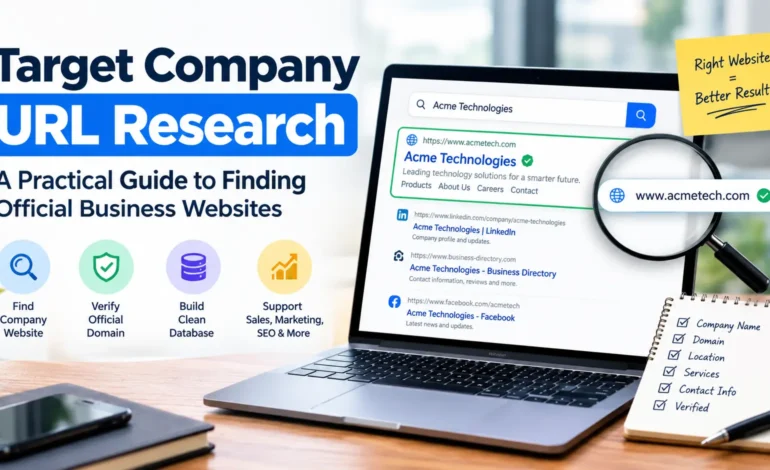
Finding the correct website for a company sounds simple, but it can become surprisingly difficult when you are working with a large list of businesses. A company name alone does not always tell you which website is the official one. There may be several businesses with similar names, social media profiles, directory listings, review websites, or outdated domains appearing in search results.
This is where Target Company URL Research becomes useful. It is the process of identifying, checking, and confirming the official website or domain associated with a specific company. The goal is not simply to find a website that looks relevant, but to determine whether that website actually belongs to the business you are researching.
Accurate company URL research is useful for sales teams, marketers, recruiters, SEO professionals, researchers, investors, and business development teams. A verified domain can become an important part of a clean and reliable company database.
What Is Target Company URL Research?
Target Company URL Research refers to the process of finding the official website of a company from its name or other available business information.
For example, suppose you have a spreadsheet containing 500 company names but no website URLs. Before researching those businesses further, you need to determine which domain belongs to each company. You might search for the business online, compare different results, verify its location and services, and then record the correct official domain.
The process becomes more complicated when:
- Several companies have similar names
- A business has recently changed its name
- The company uses a brand name different from its legal name
- Multiple domains redirect to the same website
- The business operates in multiple countries
- Search results are dominated by directories or social profiles
- The company has a limited online presence
Therefore, good URL research involves both discovery and verification.
It is also important to understand that the phrase “target company” normally refers to a company selected for a particular research purpose. It does not necessarily mean Target Corporation, the major American retail company. In business research, a target company could be a potential customer, competitor, employer, investment opportunity, or prospect.
Why Is Finding the Correct Company URL Important?
A company website is often the central source of information about a business. It can provide details about services, products, locations, industries, contact information, leadership, and company history.
If you identify the wrong domain, however, the rest of your research can also become inaccurate.
Imagine that a sales researcher is preparing a list of 1,000 potential clients. If some company names are matched with unrelated websites, the researcher may study the wrong services, contact the wrong organization, or create an inaccurate customer profile.
This makes URL verification an important part of business data collection.
Better Sales Prospecting
Sales professionals can use verified company domains to understand potential customers before contacting them. A salesperson can review the company’s services, industries, locations, and website content to create more relevant outreach.
Instead of sending a generic message, the salesperson can use information specific to the business.
Cleaner Business Databases
Company databases often contain duplicate or inconsistent records. One entry may use a legal company name while another uses a shortened brand name.
The official domain can provide another way to identify whether two records belong to the same organization.
More Accurate Market Research
Market researchers frequently begin with company names and then investigate each organization. Having the correct URL makes it easier to study competitors, products, services, business models, and online strategies.
More Reliable SEO Research
SEO professionals often analyze competitors by looking at their websites, content, keywords, backlinks, and site structure. If the wrong domain is selected at the beginning, the entire competitive analysis can become misleading.
For this reason, domain verification should happen before detailed SEO research.
How to Find the Official Website of a Company
A reliable Target Company URL Research process should follow a few clear steps rather than simply copying the first search result.
1. Start With the Exact Company Name
Begin with the company name exactly as it appears in your source list.
If the company name includes a legal suffix such as:
- Inc.
- LLC
- Ltd.
- Corporation
- GmbH
- PLC
try searching both the complete name and the shorter business name.
A company may officially be registered under one name while marketing itself using a shorter brand name.
2. Search the Company Name Online
Use a search engine to look for the business name and examine the results carefully.
Do not automatically select the first result.
Look for signs that connect the website to the company, including:
- Business name
- Logo and branding
- Products or services
- Physical location
- Phone number
- Email address
- About page
- Company description
The more information that matches, the stronger the evidence that you have found the correct website.
TechTrendery.com USA: Website, Content and Reliability Guide
3. Check the Business Location
Location is particularly useful when companies have common names.
For example, imagine you are researching a company called “Prime Roofing.” There may be several roofing businesses using that name across different cities.
If your original company record says the business is located in Manchester, a website showing a completely different city should be treated carefully.
Location does not prove ownership by itself, but it can help eliminate incorrect matches.
4. Compare Products and Services
The services listed on the website should match the business you are researching.
If your target company is a software development agency but the website you found sells clothing, it is obviously not the correct match even if the company names look similar.
This simple comparison can prevent many research errors.
5. Check Contact Information
Contact details are another useful verification signal.
Compare the phone number, email address, physical address, and other information available from your original company record.
If several important details match, confidence in the URL increases.
Manual Research vs. Automated URL Research
When you only have five or ten companies to research, manual searching can be practical.
However, manually finding websites becomes much more time-consuming when your list contains hundreds or thousands of businesses.
This is where automated company URL research tools can help.
A dedicated tool can process company names and provide potential domain matches. Instead of searching for each company individually, researchers can work through a structured list.
Automation can be especially useful for:
- Sales prospect lists
- Recruitment databases
- Lead generation
- Market research
- Competitor research
- CRM cleanup
- Account-based marketing
- SEO research
However, automation should not completely replace verification.
An automated system may identify a domain that appears to match a company name but actually belongs to another organization. This can happen when names are similar, businesses have recently changed domains, or information in the underlying database is incomplete.
The most practical approach is to use automation for discovery and speed, followed by manual verification for uncertain records.
Read more: GrammarVista.com USA: Complete Guide and Review
Common Problems When Researching Company URLs
Finding official company websites is not always straightforward. Several common issues can make URL research difficult.
Similar Company Names
Two completely unrelated businesses may have nearly identical names.
This is one of the biggest risks when building company databases.
Always compare multiple details rather than relying on the company name alone.
Social Media Profiles
A company may appear on LinkedIn, Facebook, Instagram, or another social platform before its official website appears prominently in search results.
These profiles can help confirm that a business exists, but they should not automatically be recorded as the company’s official website.
Business Directories
Directories and review platforms can be useful research sources, especially for local businesses. However, a directory listing is different from the company’s own website.
Use third-party listings as verification clues rather than automatically treating them as the official domain.
Multiple Domains
A company may own several domains.
For example, it might have:
- A main .com domain
- A country-specific domain
- An older domain
- A campaign-specific domain
- A domain that redirects to another website
Your database should normally identify the primary website currently used by the business.
Rebranding and Domain Changes
Companies frequently rebrand, merge, acquire other businesses, or change their online identity.
A URL that was correct several years ago may now redirect somewhere else or no longer belong to the same organization.
This is why important company databases should be reviewed periodically.
Target Company URL Research for Sales and Lead Generation
Sales teams can benefit significantly from accurate company URL research.
Suppose you are building a prospect list for a specific industry. You may have company names collected from directories, LinkedIn, industry databases, or other sources.
Before starting outreach, you can identify the official website for each company.
Once the domains are verified, researchers can collect additional information such as:
- Main services
- Target customers
- Business locations
- Industry
- Contact details
- Key products
- Company size
- Website structure
- Recent business activity
This information can help sales teams understand who they are contacting.
It also makes it easier to segment prospects according to industry, location, business type, or service requirements.
Using Company URL Research for SEO
SEO professionals often need accurate competitor domains before beginning an analysis.
Once the correct websites have been identified, an SEO team can investigate areas such as:
- Organic keywords
- Website content
- Search visibility
- Site architecture
- Internal linking
- Backlink profiles
- Service pages
- Blog content
- Local landing pages
- Competitor gaps
For example, if an SEO specialist is analyzing ten competitors, selecting an unrelated website for even one company can distort the research.
Correct domain identification should therefore be treated as the first step in competitor analysis.
How to Build a Reliable Company URL Database
A professional company URL database should contain more than just a business name and domain.
Depending on the project, useful fields may include:
| Field | Purpose |
| Company Name | Identifies the business |
| Official URL | Records the primary website |
| Country | Helps distinguish similar companies |
| City | Adds location context |
| Industry | Helps organize businesses |
| LinkedIn URL | Provides an additional verification source |
| Verification Status | Shows whether the domain has been confirmed |
| Verification Date | Shows when the URL was checked |
| Notes | Records unusual cases or additional details |
You do not necessarily need every field for every project. The right structure depends on the purpose of the database.
For a simple prospecting list, company name, website, location, and verification status may be enough.
For a large research project, additional fields can make the database much more useful.
Add a Verification Status
One simple improvement is to create a verification column.
You could use statuses such as:
- Verified
- Needs Review
- Not Found
- Redirected
- Uncertain
This prevents questionable URLs from being mixed with confirmed company websites.
For example, if an automated tool suggests a domain but you cannot confidently verify it, mark the record as “Needs Review” instead of treating it as confirmed.
This small step can significantly improve data quality.
Keep Your Company URLs Updated
Company URL research should not always be considered a one-time task.
Businesses change over time. They may:
- Rebrand
- Change domains
- Merge with another company
- Acquire another business
- Close their website
- Launch a new website
- Expand into another country
For databases that are regularly used for sales, marketing, or SEO, periodic URL verification can prevent outdated information from accumulating.
Adding a verification date makes this process easier. Older records can be reviewed first, while recently verified URLs can remain in the database until the next scheduled check.
Best Practices for Target Company URL Research
To improve both speed and accuracy, follow a consistent process.
Use Multiple Verification Signals
Do not rely only on the company name. Compare the name, location, services, branding, contact details, and other available information.
Separate Discovery From Verification
Finding a possible domain and confirming that it is correct are two different steps.
Treat them separately.
Use Automation for Large Lists
If you have hundreds of companies, automated tools can reduce repetitive manual work.
Manually Review Uncertain Matches
High-value prospects, similar company names, international businesses, and unusual cases deserve additional checking.
Keep Your Database Consistent
Use the same naming and URL format throughout your spreadsheet or CRM.
Record Verification Dates
Knowing when a URL was checked makes future database maintenance much easier.
Do Not Treat Third-Party Profiles as Official Websites
Directories, social media accounts, and review platforms can provide useful supporting information, but they are not automatically the company’s primary domain.
Final Thoughts
Target Company URL Research is a small but important part of accurate business research. Whether you are building a sales prospect list, cleaning a CRM, researching competitors, conducting market analysis, or preparing an SEO campaign, identifying the correct company website gives you a reliable starting point.
The key is to look beyond the first search result. A company name alone is not enough to confirm a domain. You should compare the business name, location, services, branding, contact details, and other available information before marking a URL as verified.
For small lists, manual research can work well. For large datasets, automated URL research tools can save substantial time. The most reliable workflow combines both approaches: use automation to discover potential domains and human verification to handle uncertain or important records.
When your company database contains accurate and verified URLs, every stage of your research becomes easier. Sales teams can research better prospects, marketers can analyze competitors more accurately, SEO professionals can study the right websites, and businesses can maintain cleaner and more useful data.