Decoding Digital Slang and High-Intensity Fitness: What “SMH” Means and How Tabata Training Works
The way people communicate has changed dramatically over the past few decades. From the early days of AOL Instant Messenger to today’s fast-scrolling social media feeds, digital conversation has developed its own vocabulary — one built on shorthand, acronyms, and quick expressions that pack a lot of meaning into just a few letters. At the same time, the fitness world has developed its own specialized language, with terms borrowed from scientific research that have made their way into everyday gym talk. Two such terms — “SMH” and “Tabata” — show up constantly online and in conversation, yet many people still aren’t entirely sure what they mean or where they came from. This article breaks down both.
What Does “SMH” Mean?
If you’ve spent any time texting, scrolling through social media, or reading online comments, you’ve likely come across the letters “SMH.” It’s one of the most common acronyms in digital communication, and understanding it can help you follow conversations more easily and avoid confusion when someone drops it into a message.
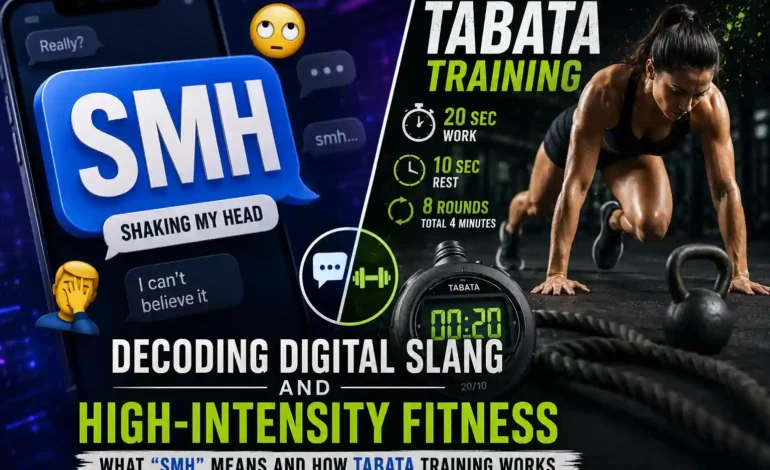
At its core, SMH stands for “shaking my head.” It’s a way of expressing disbelief, disappointment, frustration, or disapproval without having to type out a full sentence. Think of it as the text-based version of literally shaking your head at something you find hard to believe or something you don’t agree with.
The acronym is typically written in lowercase — “smh” — and has become a fixture of digital culture, showing up everywhere from text messages to comment sections to social media captions.
The Many Uses of SMH
People reach for SMH in a variety of situations, but they all share a common thread: some kind of exasperated or disapproving reaction. A few common ways it gets used include:
- Reacting to surprising or frustrating news, such as commenting on an unexpected reunion between two people
- Responding to an opinion the sender disagrees with, like someone claiming they don’t enjoy a beloved movie franchise
- Expressing frustration over something like an inflated price at a bar or restaurant
In each case, the acronym functions as a compact way to signal “I can’t believe this” or “this isn’t right” without elaborating further.
Alternative Meanings of SMH
While “shaking my head” is by far the most widely recognized meaning, slang is fluid, and it can shift depending on location, community, or context. A handful of other interpretations have popped up over time, including:
- So Much Hate — used to express disappointment mixed with negativity
- So Much Hype — used to convey excitement or anticipation, essentially flipping the tone into something positive
- Scratching My Head — used to convey confusion or bewilderment rather than disapproval
- Suck My Hole — a more vulgar usage meant as an insult
There is also, less commonly, a usage among some younger users where SMH is taken to mean “sex might help,” which carries more mature connotations. Because acronyms like this can carry multiple meanings depending on who’s using them, context is usually the best clue for figuring out which one applies in a given conversation. This is particularly worth knowing for parents trying to understand how their children communicate online — having open, ongoing conversations about digital slang is one of the simplest ways to stay in the loop.
SMH in Text Messages
The meaning of SMH doesn’t change much when it moves from social media into text messages — it’s used the same way, just in a more private, one-on-one setting. Typical examples include reacting to a teacher assigning extra work, commenting on someone’s lack of tact, or poking fun at an outrageous fashion choice. In all these cases, the acronym serves as a quick emotional punctuation mark at the end of a message.
Beyond Slang: Other Uses of the Letters “SMH”
It’s worth noting that not every instance of “SMH” in print refers to the slang term. The letters also appear as an abbreviation in other contexts entirely unrelated to texting culture. For example, SMH is used as shorthand for certain financial instruments, such as exchange-traded funds tracked by their ticker symbol, where analysts might discuss how the fund’s price movement compares to its volatility index or to other holdings in a sector. The letters have also been used as an abbreviation for organizational or publication names in journalism and other formal writing, and even as a dedication or reference within written works such as books. Because the same three letters can carry very different meanings depending on where they appear, it’s the surrounding context — whether it’s a casual text conversation or a formal piece of writing — that ultimately determines what “SMH” is referring to.
Other Ways to Express the Same Idea
If you’re looking for alternatives to SMH, there are plenty of other words, phrases, and even emojis that convey a similar sentiment of disbelief or exasperation:
- Sigh
- Eye-roll
- “Really?”
- “I can’t believe it”
- “Are you kidding me?”
- Ridiculous
- The facepalming emoji 🤦
- The face with rolling eyes emoji 🙄
- The exploding head emoji 🤯
Whether typed out in words or expressed through an emoji, these all capture the same basic reaction that SMH is meant to convey.
Why Understanding Slang Matters
Digital slang evolves quickly, and staying familiar with common terms — even ones that feel obvious to frequent internet users — can make conversations easier to follow, whether you’re texting a friend, reading comments online, or simply trying to keep pace with how language shifts in digital spaces. For parents in particular, understanding acronyms like SMH can be a useful window into how younger generations communicate, and it opens the door to more meaningful conversations about online activity.
What Is Tabata Training?
Switching gears entirely, from digital slang to physical fitness, another term that shows up constantly but isn’t always well understood is “Tabata.” Unlike SMH, Tabata isn’t shorthand for anything — it’s named after the researcher who developed it, and it refers to a specific, highly structured style of workout that has become a staple in gyms and fitness routines around the world.
The Basic Structure
Tabata is a form of high-intensity interval training, or HIIT. The format is simple on paper but demanding in practice: it consists of eight rounds of fast-paced exercise, with each round lasting 20 seconds, followed by just 10 seconds of rest. That cycle repeats eight times, which adds up to a total workout time of exactly four minutes — a calculation that comes out to (8 x 20) + (8 x 10) = 240 seconds.
The TikTok Rizz Party: How a Random Sweet 16 Video Became an Internet Sensation
Where Tabata Came From
The method traces back to the research of Japanese scientist Dr. Izumi Tabata and his team at the National Institute of Fitness and Sports in Kagoshima Prefecture, Japan, during the early 1990s. Their goal was to investigate whether short bursts of maximum-effort exercise, paired with very brief rest periods, could condition the body more effectively than a longer, steadier workout performed at a moderate pace.
To test this, the researchers split participants into two groups. One group followed a moderate-intensity routine: one-hour workouts, five days a week, for six weeks. The other group followed the high-intensity approach that would eventually become known as the Tabata protocol: four-minute workouts, four days a week, for six weeks, with each session made up of the eight rounds of 20-second maximum-effort exercise separated by 10-second rests.
What the Research Found
The results revealed a clear difference between the two approaches. The moderate-intensity workouts improved participants’ aerobic, or cardiovascular, fitness, but had little effect on anaerobic capacity — meaning they didn’t do much for muscle strengthening. The high-intensity workouts, by contrast, produced meaningful improvements in both aerobic and anaerobic fitness. Researchers attributed this to the unbalanced ratio between exercise and rest: because the rest periods were so short, the body never fully recovered between bursts of effort. By the second half of the workout, the body was forced to operate at its physiological limit, which increased both heart rate and metabolic rate. The end result was a workout that built both endurance and muscle while also burning a significant number of calories — all in just four minutes of effort performed four or five days a week. This is what gave rise to the now widely recognized “Tabata 20-10” format: 20 seconds of intense exercise, 10 seconds of rest, repeated throughout the workout.
How Tabata Is Used Today
While the basic structure of Tabata training hasn’t changed since Dr. Tabata’s original research, the exercises used within that structure have evolved considerably. In the original study, the primary exercise was pedaling a stationary bike at full intensity. Today’s Tabata workouts tend to be far more varied and demanding, often incorporating advanced, full-body movements such as burpees, medicine ball slams, lunges, and kettlebell swings — all performed at maximum effort during each 20-second interval. The combination of these more intense exercises with the original short-burst, short-rest structure makes for an especially challenging four minutes of exercise.
Why Tabata Has Stayed Popular
Part of the appeal of Tabata training is its efficiency. For people who want the benefits of a high-intensity cardio workout but don’t have the time — or the desire — to commit to an hour-long gym session, Tabata offers a way to get a serious workout done in a fraction of the time. Because the format is so short, it can also be repeated multiple times within a single workout, layering several four-minute Tabata sets together for an even more intense overall session, or paired with other types of exercise as part of a broader fitness routine.
Bringing It All Together
At first glance, an internet acronym and a Japanese researcher’s interval training method might not seem to have much in common. But both “SMH” and “Tabata” illustrate something similar: how specific, sometimes technical origins — whether a scientific study or the shorthand habits of digital communication — can evolve into widely recognized terms used by millions of people in everyday life. Understanding where these terms come from, and the different ways they’re used, makes it easier to navigate both online conversations and fitness culture with more confidence.