Betty Boop: The Rise, Censorship, and Legacy of an Animated Icon
Introduction
Betty Boop is one of the most recognizable cartoon characters in American history, her image printed on everything from luggage to mugs to shoes nearly a century after she first appeared on screen. Yet behind the familiar flapper silhouette lies a complicated story of artistic experimentation, sexualized humor, government-pressured censorship, contested origin myths, and a long afterlife in pop culture that continues today, including a recent Broadway musical.
From Cartoon Dog to Cartoon Star
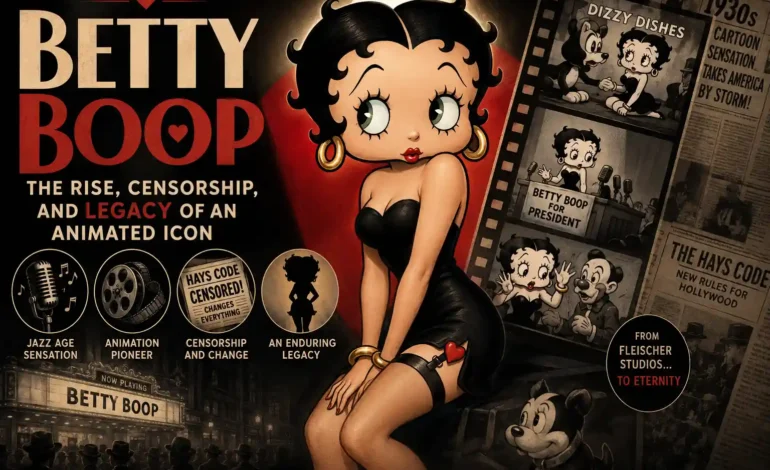
Betty Boop was created by brothers Max and Dave Fleischer at Fleischer Studios and first appeared on August 9, 1930, in the animated short “Dizzy Dishes.” In that debut she was not drawn as a human at all — she was an anthropomorphic dog with floppy ears and a button nose, introduced as a love interest for the studio’s existing canine star, Bimbo, in the “Talkartoons” series. Audiences responded strongly to her scat-singing style and her risqué black dress, and the studio quickly built her into a headline attraction of her own.
By 1931 and 1932, the character had been redesigned as fully human: her floppy ears became hoop earrings, her eyes shrank and rounded, and she took on the appearance most people recognize today — a strapless minidress, a garter visible above the knee, and large hoop earrings. She became, by most accounts, the first cartoon character who was both fully human and fully female to headline her own series. Notably, her boyfriend Bimbo remained a dog even after her transformation, a detail that fit comfortably into the surreal logic of Fleischer’s animated world.
An Unusual Kind of Star
Unlike Disney’s Minnie Mouse, who largely served as a supporting character to Mickey, Betty was the lead of her own films, with two male co-stars, Bimbo and Koko the Clown, effectively working in support of her. Contemporary press coverage in the early 1930s described her as an “overnight hit” and compared her popularity to major stars such as Greta Garbo. At a time when animated shorts were typically just an opening act before a feature film, Betty’s cartoons were themselves a draw — audiences came to theaters specifically to see her.
Over the course of her run she was cast in an enormous range of roles: circus performer, race car driver, airplane pilot, courtroom judge, inventor, dentist, and even, in the 1932 short “Betty Boop for President,” a presidential candidate who cures the Great Depression and hands out free jazz and ice cream. That film is considered one of the earliest works of American fiction to depict a woman as president, and notably it didn’t treat her gender as a punchline — the humor centered on her improvised, whimsical solutions to real-world problems.
Sex Symbol and Surreal Star
Betty was explicitly marketed and understood by contemporary audiences as a sex symbol, described in the trade press of the era for her “doll-like face” combined with a “mature figure.” At the same time, this sexualization came with a darker recurring plot device: many Betty Boop shorts revolved around male characters pursuing her, cornering her, or attempting to force themselves on her, with the “joke” of the cartoon often built around her narrow escape. In “Boop-Oop-a-Doop” (1932), for example, her circus boss corners her in her dressing tent before Koko intervenes. Film historians studying the character have noted that while Betty was more fully realized than most female cartoon characters of her era, the material built around her sexuality reflected the era’s casual treatment of assault as comedic fodder — a pattern that also appeared in other studios’ work of the period, including early Mickey and Minnie Mouse shorts.
Visually and tonally, the Fleischer studio distinguished itself from its chief rival, Disney, by embracing a grittier, more chaotic, urban aesthetic rather than pastoral fairy-tale settings. Dave Fleischer reportedly required animators to insert a sight gag or bit of comic business into every single shot, and the results were often described by later critics and historians as strikingly surrealist — inanimate objects came to life, backgrounds morphed unpredictably, and musical numbers (frequently performed by guest jazz musicians such as Cab Calloway and Louis Armstrong) took on a hallucinatory quality. Calloway’s rotoscoped dance moves, mapped onto a ghostly animated walrus in “Minnie the Moocher” (1932), are often cited as one of the studio’s most memorable achievements, and have been credited by later filmmakers such as Tim Burton as an influence on their own work.
Among the studio’s most celebrated shorts is “Snow-White” (1933), released four years before Disney’s own animated feature on the same fairy tale. The seven-minute Fleischer short — animated single-handedly by veteran animator Roland Crandall as a reward for his years with the studio — includes bizarre imagery such as the villainous queen’s face transforming into eggs frying in a pan and Betty being transported down a mountain in an ice-block coffin. It was later preserved in the National Film Registry. Other frequently cited highlights from Betty’s peak years include “The Old Man of the Mountain” (1933), “I’ll Be Glad When You’re Dead You Rascal You” (1932), and “Poor Cinderella” (1934), her only appearance in color, produced using an early two-strip color process.
The Helen Kane Lawsuit and the Baby Esther Question
Betty’s vocal style and persona were widely understood at the time to be a caricature drawing on the broader “baby vamp” performance style popular among Jazz Age singers. One of the most visible of those performers was Helen Kane, a white singer known for a childlike voice and scat-style “boop-oop-a-doop” vocals. In 1932, Kane sued Fleischer Studios and Paramount, arguing that Betty Boop was a deliberate copy of her personal style, voice, and image.
The lawsuit brought forward important testimony about the broader history of scat singing. Black musician Clarence Williams testified that he had been scat-singing since 1915, well before Kane’s rise to fame, and evidence was presented that a number of Black performers — including Gertrude Saunders, Florence Mills, and a child performer known as “Baby Esther” (Esther Jones) — had used similar vocal techniques and styles throughout the 1920s. Baby Esther’s manager testified that she had been performing in this style since 1928 and that he had seen Kane attend one of Baby Esther’s performances at a Manhattan nightclub that same year, a claim reportedly corroborated by Kane’s own manager, along with recordings of Baby Esther’s singing presented as evidence. The court ultimately ruled against Kane, finding that she could not claim exclusive ownership over a vocal and visual style that was not unique to her and that had circulated among multiple performers before her rise to fame.
This history became the subject of renewed controversy decades later. In 2021, it came to light that a Public Broadcasting Service (PBS) web page promoting Black History Month programming had, since 2015, been running an item flatly asserting that Betty Boop “was” Esther Jones — that is, presenting Baby Esther not merely as one influence among several Jazz Age performers, but as the direct, singular real-life basis for the character. That framing was amplified further when actress Taraji P. Henson referenced it during a televised awards show monologue. Max Fleischer’s grandson, Mark Fleischer, who leads the company holding rights to the character, wrote to PBS raising concerns that the network was functioning as an authoritative-seeming source for an inaccurate origin story. PBS ultimately removed the item and replaced it with an editor’s note stating the content could not be verified, acknowledging the original post had not been properly sourced. Fleischer and others involved in the discussion have emphasized that while Betty Boop was shaped by the broader Jazz Age culture — including real contributions from Black performers such as Esther Jones — she was not modeled on any single individual, Black or white.
Read also: Italian Brainrot: Inside the Absurd AI Meme Trend Taking Over Gen Alpha
The Hays Code and Betty’s Makeover
Betty’s freewheeling, risqué persona collided with a broader wave of film industry self-regulation in the mid-1930s. Following a series of Hollywood scandals in the 1920s that triggered state-level censorship laws, the industry’s trade organization adopted the Motion Picture Production Code in 1930 — commonly called the Hays Code, after MPPDA president Will Hays — which set strict rules against depicting suggestive dress, “lustful” behavior, and indecent exposure on screen. The Code was enforced for live-action films starting in 1934 and extended to animation shortly after.
The effects on Betty Boop were immediate and visible. Her dresses were lengthened to cover the once-iconic garter, her figure and overall look were softened, and she was aged up in appearance. Her personality and storylines shifted correspondingly, moving away from adventurous, risqué, and often surreal plots toward domestic, “wholesome” scenarios. Koko the Clown was phased out in favor of a new character, the elderly inventor Grampy, and Bimbo was replaced by a pet puppy named Pudgy. Cartoons from this later period showed Betty bathing a stubborn dog or overwhelmed by demanding hotel guests rather than fleeing villains or running for president. Contemporary press at the time noted plainly that she had “lost the curves” because of the censors. Industry enforcer Joseph Breen reportedly singled out Betty’s hip movements specifically as “suggestive of immorality.”
Historians who have studied the character have connected this shift to broader social anxieties of the Great Depression era, when resentment toward working women intensified as unemployment rose; Betty, as a visible “working girl” in revealing dress, became a target for that cultural pressure in ways that fed into arguments for reshaping her image into something more conventionally domestic. Fleischer’s grandson has described the Code’s enforcement as effectively “the beginning of the end” for the character, suggesting the studio largely lost creative enthusiasm for her stories once required to sanitize them, even as it continued producing new shorts to fulfill its output obligations.
Decline and Dormancy
Fleischer Studios retired the Betty Boop series in 1939, and the studio itself — by then acquired by Paramount and reorganized — soon ceased operating under the Fleischer name. Betty largely disappeared from new production for over a decade. In 1955, Paramount sold much of its pre-1950s cartoon catalog to a television syndicator, which returned Betty’s earlier cartoons to public visibility through television reruns, even as no new material was being produced. In the following decades she appeared mainly through licensed merchandise and occasional cameos, including a 1985 television special, “The Romance of Betty Boop,” and a brief appearance in the 1988 feature film “Who Framed Roger Rabbit.”
A Continuing Legacy
Today, a family-run revival of Fleischer Studios continues to manage and expand Betty Boop’s image, presenting her both as a nostalgic pre-Code flapper icon and as a more modern figure who has been reimagined riding motorcycles, practicing yoga, using contemporary internet slang, and appearing in casual clothing such as ripped jeans and sneakers in newer merchandise and social media content. A self-help book released in recent years, co-developed by Mark Fleischer’s wife, presents Betty promoting values such as independence and self-care while dressed in jeans rather than her classic minidress.
Betty’s cultural footprint extends to the stage as well: “Boop! The Musical,” built around the character, received multiple Tony Award nominations, including a nomination for its star in the leading role. Interest in the character’s original cartoons has also led to new restorations of classic shorts by outside preservation groups, introducing decades-old material to contemporary audiences who may know Betty primarily as a nostalgic image rather than as the star of an idiosyncratic and often bizarre body of 1930s animated work.
Conclusion
Betty Boop’s history reflects competing forces that shaped American entertainment in the early twentieth century: the freewheeling, boundary-pushing style of early sound-era animation; the casual sexualization of female characters typical of the period; the blunt force of industry censorship once the Hays Code took hold; contested and sometimes oversimplified claims about her real-world inspirations; and a decades-long afterlife as a licensed commercial icon. As one critic put it, Betty Boop’s legacy is ultimately one of contradiction — a character created within and shaped by the male gaze of her era, who nonetheless became one of animation’s most enduring and adaptable symbols of unapologetic female presence on screen.