Different Types of Settlements You Can Reach With a Texas Eminent Domain Attorney

When the government or another authorized entity seeks to take private property in Texas, landowners often assume their only options are accepting the initial offer or fighting the condemnation in court. However, eminent domain disputes can result in several different types of settlements, depending on the property, the proposed project, and the damages involved.
Working with a Texas eminent domain attorney can help property owners understand their rights, evaluate the compensation being offered, and negotiate agreements that address both immediate financial losses and long-term property impacts.
Not every settlement involves simply increasing the amount of money paid for land. Some agreements address access restrictions, construction impacts, easement terms, and the future usability of the remaining property.
Understanding these potential outcomes can help Texas landowners make informed decisions before signing an agreement that may permanently affect their property.
1. Financial Compensation Settlements

One of the most common outcomes in a Texas eminent domain case is a negotiated financial settlement.
Under Texas law, property owners generally have the right to receive adequate compensation when their property is taken for a legally authorized public use.
The initial offer from a condemning authority may not fully reflect the property’s value or the financial consequences of the proposed taking.
An eminent domain attorney may negotiate for additional compensation by examining several factors:
- The property’s fair market value.
- Its highest and best legally permissible use.
- Comparable property sales and market conditions.
- Existing commercial or agricultural uses.
- Improvements, structures, and other property features.
- The impact of the taking on the remaining property.
For example, a landowner may receive an initial offer of $150,000 for property needed for a highway expansion. After reviewing the appraisal and obtaining additional valuation evidence, the owner’s attorney may negotiate a higher amount supported by the property’s market value and compensable damages.
The final settlement depends on the evidence, applicable law, and the willingness of the parties to reach an agreement.
2. Partial Taking and Remainder Damage Settlements
Not every eminent domain case involves taking an entire property.
In Texas, many condemnation projects involve partial takings, where a government agency, utility company, or another authorized entity acquires only a portion of a larger parcel.
Although the landowner retains ownership of the remaining property, that property may become less valuable or more difficult to use.
These impacts can include reduced road frontage, altered access, irregular parcel configurations, diminished development potential, and changes affecting commercial operations.
A settlement involving a partial taking may compensate the owner for both the land acquired and legally compensable damages to the remaining property.
For example, a retail property might lose part of its parking area to a roadway expansion. Even if the amount of land taken is relatively small, the reduction in usable parking could affect the property’s overall market value.
An experienced Texas eminent domain attorney can work with appraisers, engineers, and other specialists to determine whether these losses support additional compensation.
3. Easement Settlements
Easement settlements are especially common in Texas because of the state’s extensive infrastructure, energy, and utility development.
An easement allows another party to use a defined portion of private property for a particular purpose without necessarily acquiring full ownership.
Common examples include pipeline easements, electrical transmission easements, drainage easements, and utility access corridors.
Unlike a straightforward land purchase, an easement can create continuing restrictions on how a property owner uses the affected land.
A negotiated easement settlement may address compensation as well as:
- The exact location and width of the easement.
- Restrictions on future construction or development.
- Access rights for maintenance and repairs.
- Restoration of disturbed land.
- Responsibility for certain types of property damage.
- Limitations on surface activities and equipment placement.
For agricultural landowners, these terms may be particularly important because utility infrastructure can interfere with fencing, livestock movement, irrigation systems, or farming operations.
An attorney may negotiate provisions that reduce unnecessary interference while securing compensation for the rights acquired.
The precise terms depend on the condemning entity’s legal authority and the requirements of the project.
4. Property Access and Operational Impact Settlements
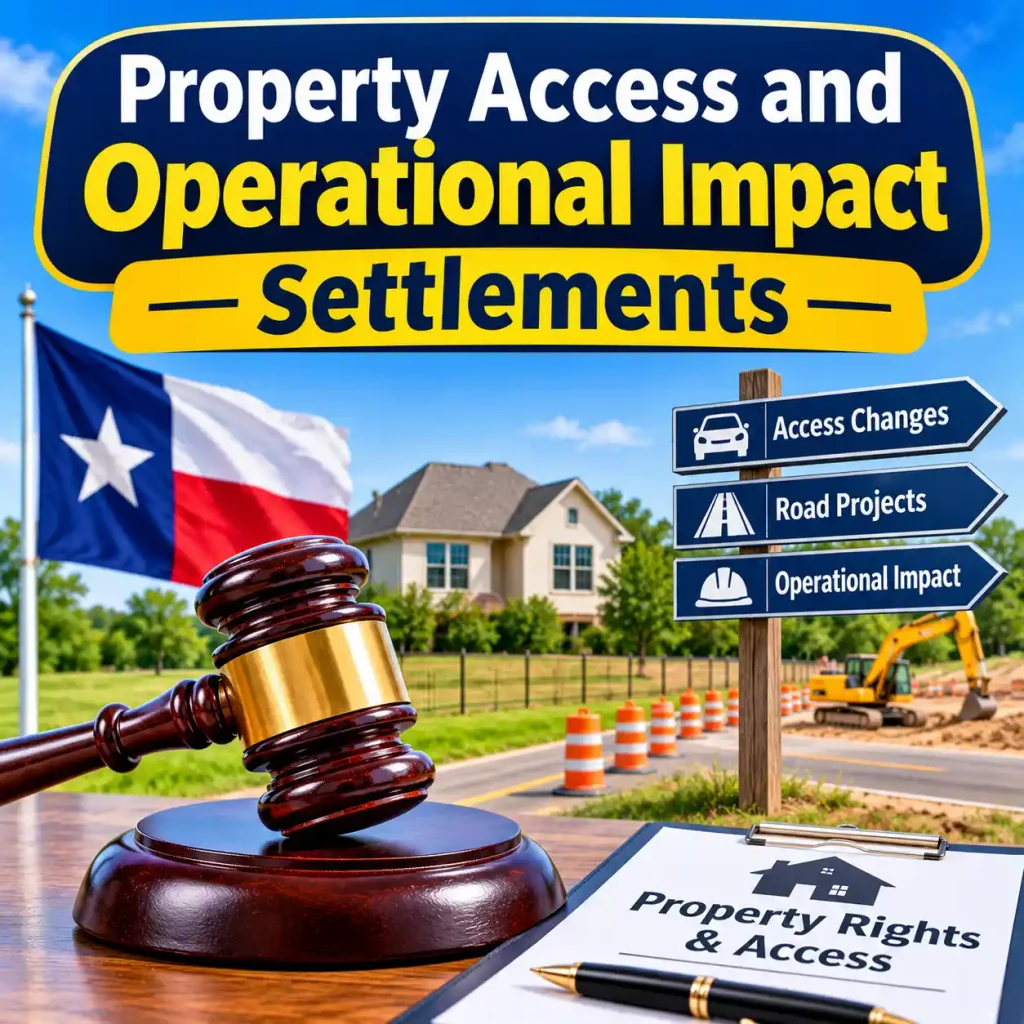
Access is one of the most significant issues in many Texas eminent domain disputes.
A property may retain substantial acreage after a taking but become less functional because of changes to entrances, driveways, road connections, or internal circulation.
Commercial properties can be especially vulnerable to these changes.
For example, a warehouse may lose convenient truck access after a road project. A shopping center may experience changes to vehicle circulation. A farm may be divided by a transportation corridor, making it more difficult to move equipment between fields.
A settlement may involve compensation for legally recognized access-related damages or negotiated project modifications designed to preserve functionality.
Potential negotiated solutions include revised driveway locations, alternative access routes, modified construction plans, or other improvements.
However, Texas law does not automatically compensate every inconvenience or traffic-related change. Whether an access restriction creates a compensable property injury depends on the specific facts and applicable legal standards.
A knowledgeable attorney can distinguish between ordinary project inconveniences and legally compensable interference with property rights.
5. Construction Damage and Property Restoration Settlements
Some eminent domain agreements address what happens during and after construction.
Even when the condemning authority acquires only a limited property interest, construction activity may affect surrounding land, landscaping, fencing, drainage systems, and other improvements.
A negotiated agreement may establish responsibilities for restoring affected property.
Depending on the project, settlement provisions might address replacement fencing, restoration of disturbed soil, repair of drainage features, reconstruction of access improvements, or restoration of affected surfaces.
These provisions can be particularly valuable for agricultural and commercial properties where construction disturbances may interfere with operations.
It is important to distinguish between damages compensable under eminent domain law and additional restoration obligations negotiated as contractual terms.
A Texas eminent domain attorney can help ensure that restoration requirements are sufficiently specific to reduce future disputes about the condemning authority’s responsibilities.
6. Relocation Assistance and Moving Expense Settlements
When an eminent domain project requires a property owner, tenant, or business to relocate, additional financial considerations may arise.
Relocation expenses can include moving equipment, transporting inventory, securing replacement facilities, and other qualifying costs associated with displacement.
Texas Property Code Section 21.046 authorizes certain relocation assistance, and federally funded projects may involve additional requirements under federal relocation law.
However, relocation benefits are not automatically available in every condemnation case. Eligibility depends on the project, the acquiring authority, and the applicable legal framework.
Texas Legislative Online+1
An attorney can evaluate whether a landowner or displaced business qualifies for relocation assistance and whether additional relocation-related terms can be negotiated.
For business owners, this analysis can be especially important when a taking affects specialized equipment, production facilities, or operational infrastructure.
7. Full Property Acquisition Settlements
In certain situations, a partial taking may leave the remaining property with limited practical or economic value.
A landowner might prefer to negotiate the acquisition of the entire property rather than retain a severely compromised remainder.
For example, a highway project may acquire a substantial portion of a commercial tract, leaving a parcel that is too small or irregularly shaped to support its previous use.
In some circumstances, an attorney may negotiate a full acquisition instead of a partial taking.
Texas Transportation Code Section 203.052 addresses certain circumstances in which the Texas Department of Transportation may acquire an entire tract, including situations where the remainder has little or no value or utility to the owner.
Texas Statutes
A complete acquisition can sometimes provide a more practical resolution, but the condemning authority must have the necessary legal authority, and the terms must be acceptable to the parties.
8. Pre-Trial and Litigation Settlements
Not every Texas eminent domain dispute reaches a jury.
Texas law requires condemning entities to follow specific procedures, including making a bona fide offer before initiating condemnation proceedings.
If the parties cannot agree, the condemning authority may file a condemnation petition, and a court-appointed panel of special commissioners generally determines an initial compensation award.
Parties may still negotiate a settlement during the condemnation process, including after a special commissioners’ hearing or while a contested case proceeds toward trial.
Justia Law+1
These settlements may resolve the amount of compensation, the property interests being acquired, or other disputed terms.
A settlement reached during litigation can help avoid additional litigation expenses and uncertainty. However, accepting an agreement solely to avoid trial may not serve a landowner’s interests when substantial compensation or property-rights issues remain unresolved.
A trial-ready eminent domain attorney should evaluate the strength of the evidence and the risks of litigation before recommending whether to settle.
How a Texas Eminent Domain Attorney Helps Negotiate Settlements

The value of legal representation in an eminent domain dispute extends beyond requesting a higher purchase price.
An attorney who concentrates on representing landowners can identify issues that may be overlooked during initial negotiations.
This may involve examining the condemning authority’s appraisal, retaining independent valuation experts, reviewing engineering plans, evaluating access changes, and determining whether the proposed taking exceeds the rights reasonably required for the authorized project.
Attorneys may also negotiate the language of easements, deeds, and settlement agreements to protect the landowner against unnecessarily broad restrictions.
For property owners seeking specialized representation, firms such as Matt Hurt Law focus on protecting landowners in Texas condemnation matters.
A lawyer’s willingness and ability to litigate can also influence settlement negotiations. When the condemning authority understands that the landowner has developed a credible valuation case and is prepared to proceed to trial, the parties can evaluate settlement proposals against the evidence that would be presented in court.
This does not guarantee a higher settlement. It does, however, provide a more informed basis for negotiations.
Common Mistakes Landowners Make When Evaluating Settlements
One of the most significant mistakes a Texas landowner can make is focusing exclusively on the initial dollar amount.
A settlement may appear financially attractive while creating long-term restrictions that reduce the value or usability of the remaining property.
Other common mistakes include accepting the condemning authority’s appraisal without independent review, overlooking potential remainder damages, agreeing to unnecessarily broad easement language, and failing to document existing property conditions before construction.
Landowners should also understand that settlement agreements may contain releases or other provisions affecting future claims.
Before signing, an attorney should review precisely which rights are being conveyed, what compensation is being paid, what obligations survive closing, and which potential claims are being released.
Frequently Asked Questions About Texas Eminent Domain Settlements
Can a Texas eminent domain settlement be higher than the government’s initial offer?
Yes. Landowners may negotiate compensation exceeding the initial offer when valuation evidence, compensable damages, or other negotiated considerations support a different amount. An initial offer does not necessarily establish the property’s full compensable value.
Can a landowner receive compensation for damage to property that is not taken?
Yes. Under Texas Property Code Section 21.042, certain partial takings can result in compensation for damage to the remaining property. This may include qualifying reductions in market value caused by the taking, subject to statutory and judicial limitations.
Justia Law
Can an eminent domain settlement include more than money?
Yes. Negotiated settlements may address easement boundaries, access arrangements, restoration requirements, construction conditions, and other property-specific terms. The available options depend on the condemning authority’s legal powers and the project’s requirements.
Do Texas eminent domain cases always go to trial?
No. Many disputes can be resolved through voluntary negotiations or settlement during condemnation proceedings. If the parties cannot resolve their differences, the statutory process provides mechanisms for determining compensation and, when properly contested, pursuing judicial review.
Can a landowner negotiate to keep more of their property?
Potentially. An attorney may examine whether the proposed acquisition area or property rights can be narrowed. Changes depend on the condemning authority’s legal authority, engineering needs, and willingness to modify the proposed acquisition.
Should a landowner hire an attorney before receiving a final offer?
Consulting an attorney early can be beneficial. Early legal review allows the property owner to assess the proposed acquisition, identify valuation concerns, and consider negotiating strategies before important decisions are made.
Final Thoughts: The Right Settlement Protects More Than Property Value
Texas eminent domain settlements can take several forms, from straightforward financial compensation to complex agreements involving easements, remainder damages, property access, relocation, and restoration obligations.
The most appropriate settlement depends on the landowner’s circumstances and the long-term consequences of the proposed acquisition.
Under Article I, Section 17 of the Texas Constitution, private property rights receive constitutional protection against uncompensated takings for public use. Understanding those protections is essential when evaluating a condemnation offer.
Read also: Why Are Your Energy Bills Rising Even Though Your HVAC System Still Works?







1 Comment
[…] Read also: Different Types of Settlements You Can Reach With a Texas Eminent Domain Attorney […]