How Staff Identification Builds Trust In Customer-Facing Spaces: A Guide

Key Takeaways
- Clear staff identification helps customers quickly find the right person for assistance.
- Names, roles, and visual cues should be readable while sharing only the information customers need.
- Privacy, safety, accessibility, and employee comfort should guide every identification policy.
- Consistent badges, uniforms, and role markers can make a customer-facing team easier to recognize.
- Identification supports good service, but it cannot replace helpful communication and training.
In a busy store, hotel lobby, clinic, school, restaurant, or public office, customers should not have to guess who can help them. A clear name badge, role label, uniform element, or counter sign can reduce that uncertainty and make it easier to begin a conversation. Durable options, such as Nicebadge engraved name badges, can provide organizations with a practical starting point for displaying names and roles consistently.
Staff identification is a small operational detail, but it affects how approachable a workplace feels. When visitors can quickly identify employees, they can ask for directions, request support, or raise a concern without interrupting the wrong person. The goal is not to make every interaction formal. It is to make help visible and accessible.
Why Staff Identification Still Matters
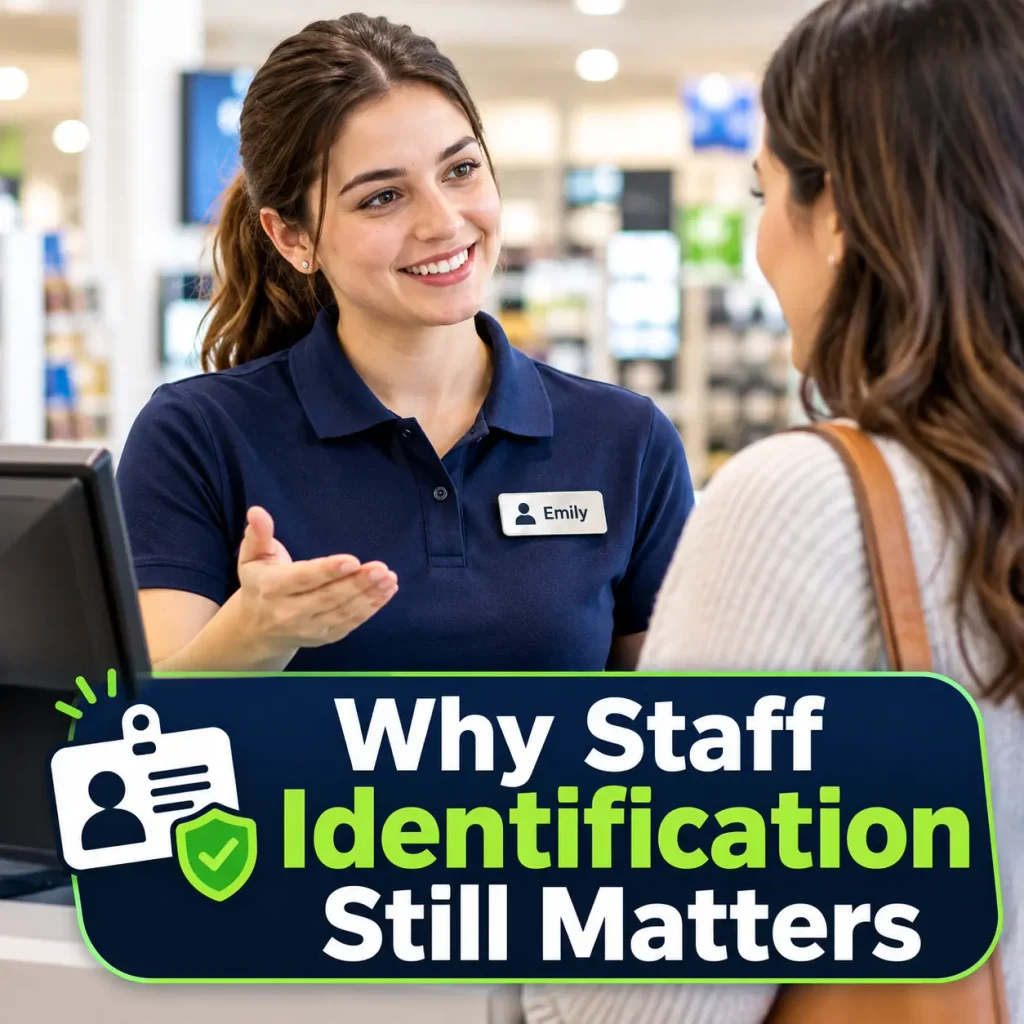
Customer-facing spaces often include people with different responsibilities. A guest may need a concierge rather than a server, a patient may need a member of the check-in team rather than a clinician, and a shopper may need help from someone assigned to a particular department. Visible role cues help customers direct questions appropriately and can reduce avoidable frustration.
Presentation also influences first impressions. Recent research on employee presentations reported that 48% of surveyed consumers backed out of a purchase because they did not trust an employee based on their presentation. Identification alone does not create trust, but an orderly, readable, and professional visual system can reinforce the sense that a team is prepared to serve customers.
How Visual Cues Shape Customer Confidence
Names, job titles, department labels, color coding, and consistent clothing each give customers useful signals. A pharmacy customer who sees “Pharmacist” on a badge knows whom to approach with a medication question. At a large event, different shirt colors may help attendees distinguish registration staff, security personnel, and technical support.
Consistency matters as much as the individual badge design. If one employee has a large, clear identifier while another has a tiny, faded label, visitors receive mixed signals about where to go. A shared format makes the team easier to scan, especially in crowded or unfamiliar settings.
The Link Between Recognition And Better Conversations
A visible first name or work name gives customers a natural starting point. “Could you help me, Jamie?” can feel warmer and more direct than trying to get someone’s attention without knowing how to address them. It can also clarify accountability when a customer needs a follow-up conversation.
For example, a hotel guest looking for local recommendations can more easily approach an employee marked “Concierge.” Likewise, a clinic visitor who sees “Patient Services” can ask for scheduling help without needing to understand the organization’s internal structure. The identifier should make the next step obvious, rather than forcing customers to decode a complicated hierarchy.
What Recent Research Suggests About Trust

Trust can grow when customers can see the people and coordination behind a service. Harvard Business School’s research on customer trust discusses a study of 2 million customer-service group messages. Customers responded more positively when they could observe signs that employees were coordinating and responding to one another.
The lesson for in-person workplaces is broader than any one messaging platform. Customers are more likely to feel confident when they can recognize who is involved, understand each person’s role, and see that the team is organized. Clear identification makes that visibility easier without exposing internal information customers do not need.
Choosing What To Display
More information is not always better. A useful identification system should display the details that help customers while avoiding unnecessary personal exposure.
Information That May Help
- First name or preferred work name
- Job title or customer-facing service role
- Department, service area, or location
- Organization name or logo
- A simple color or symbol used for wayfinding
Information That May Create Risk
- Full legal names when they are not necessary for service
- Personal phone numbers or email addresses
- Home locations or other personal details
- Social media account information
- Any information that could invite unwanted contact
Balancing Customer Access With Employee Privacy

Employees should have a meaningful voice in how their information is displayed. Depending on the setting, a first name, preferred name, initials, staff number, or role-only badge may be appropriate. Organizations should also account for workers with safety concerns, public-facing harassment risks, or a history of unwanted contact.
A clear policy should explain how staff can report harassment, stalking, or misuse of identifying information. Managers should revisit the policy when an employee changes roles, transfers locations, or takes on more public contact. The best system gives customers enough clarity to seek help while protecting the dignity and safety of the person providing it.
Making Identification Easy To Read
Readability should be tested in real-world environments, not only on a computer screen. Text needs sufficient size, contrast, spacing, and placement to be seen at a normal conversational distance. Small lettering, glossy finishes, glare, shadows, dim lighting, and constantly moving staff can all make useful information difficult to notice.
Keep layouts simple. A large first name and a clear role are often more helpful than a badge crowded with logos, credentials, decorative graphics, and tiny text. Straightforward language and recognizable symbols can also support customers with low vision, cognitive disabilities, or limited familiarity with the workplace.
Matching The Format To The Workplace
- Wearable name displays: Useful for personal interactions in retail, hospitality, and service settings.
- Role-based identifiers: Helpful when customers need to locate specialists quickly.
- Color-coded systems: Useful for large facilities, departments, and event teams.
- Digital visitor badges: Practical for offices, campuses, and temporary-access areas.
- Desk signs and counter displays: Helpful when employees work from fixed service points.
Common Mistakes To Avoid
- Using text too small to read at a normal speaking distance.
- Including too many titles, colors, logos, or decorative elements.
- Displaying more personal information than the role requires.
- Using inconsistent formats across one customer-facing team.
- Ignoring employee comfort during a full work shift.
- Leaving damaged, outdated, or inaccurate identifiers in use.
- Treating badges as a replacement for service training.
A Practical Review Process For Managers
- Define the customer need: Determine whether visitors need a name, role, department, or access level.
- Ask employees for feedback: Review comfort, privacy, readability, and daily wearability.
- Assess the environment: Consider lighting, uniforms, distance, movement, and noise.
- Create a consistent layout: Use the same basic information structure across departments.
- Test with real users: Ask staff and customers whether they can quickly identify the right person.
- Schedule reviews: Reassess after staff changes, complaints, or workplace redesigns.
Conclusion: Make Identification Clear, Useful, And Respectful
Staff identification works best when it is clear, readable, consistent, and respectful. Customers gain confidence when they can see who is available to help, while employees benefit from systems that recognize privacy, safety, and comfort. Keep the design focused on the essentials, test it in real conditions, and let good service remain the most important part of every interaction.
Read also: How Healthcare Workers Can Report Suspected Billing Fraud